Entry No. 17 — the Montreal, QC file — filed under: miscellanea
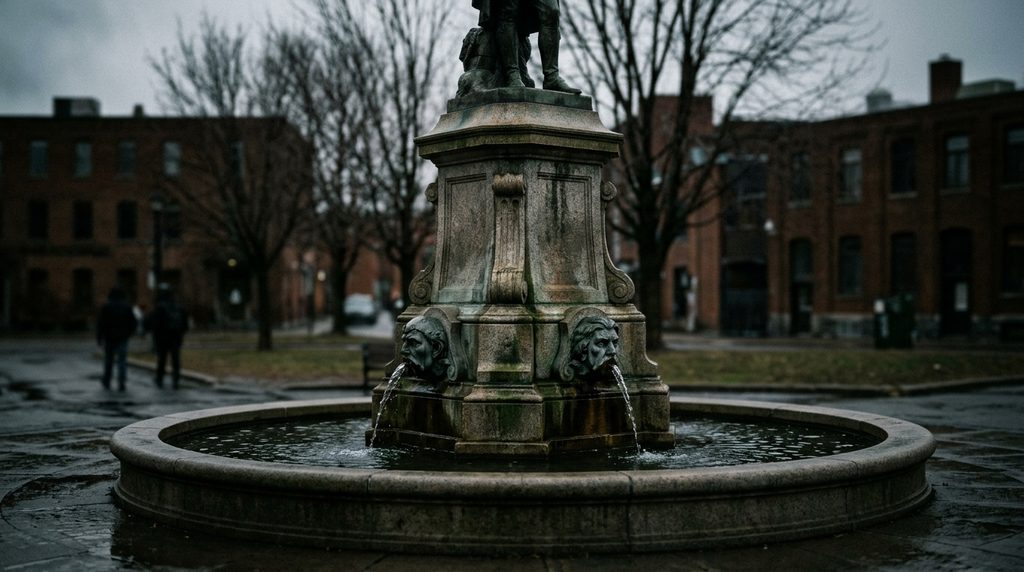
Jacques Cartier Monument in Parc Saint-Henri
The statue’s eyes are said to follow passersby, and the monument incorporates water-spouting depictions of severed Indigenous heads. Haunted Montreal credits the statue’s paranormal lore with at least one divorce.
→ Three at a time, never the same twice — explore weird Montreal, QC
The story
Erected in 1893 when Saint-Henri was still an independent working-class town, the Jacques Cartier fountain was funded by local nickel-and-dime subscriptions to assert French-Canadian pride. Sculptor Joseph-Arthur Vincent designed a 30-foot Second Empire cast-iron confection: four beavers hug the lower column, plaques herald Cartier claiming the territory for King Francis I, and Cartier himself poses up top in Renaissance puff-sleeves, arm outstretched toward the setting sun. But Vincent made a grotesque design choice at water level: four severed Indigenous heads mounted as spouts, grimacing through streams of municipal water. In recent years, local Innu surgeon Dr. Stanley Vollant sparked citywide debates over the monument after his young daughter asked why 'monsters' were spitting into the basin.
If the colonial politics aren't unsettling enough, the neighborhood folklore is downright bizarre. According to Haunted Montreal's ledgers, locals have spent decades swearing Cartier’s dead-eyed gaze follows pedestrians walking along Rue Agnès. Nocturnal cackling has been reported floating across the grass when the square is empty, and neighborhood gossip famously attributes at least one messy Saint-Henri divorce to an obsessive, sanity-fraying fixation on the effigy's nocturnal vibrations. To add to the uncanny double-take: the statue towering over the park today is actually an all-weather composite duplicate. The deteriorating 1893 original—hand-carved wood sheeted in repoussé copper—was hauled out during 1990s restorations and now lurks underground in a high light shaft inside the nearby Place-Saint-Henri metro station.
What it's like
Parc Saint-Henri is an unassuming urban square bordered by Victorian brick rowhouses and neighborhood dog-walkers, centered on a fenced-off ornamental basin. The fountain jets are often bone-dry, leaving the four disembodied bronze heads staring out over stagnant leaves or bare iron basin floor. You can easily walk right up to the perimeter fence and examine the details: the beavers, the 1530s voyage inscriptions, and Cartier's west-pointing hand. For the complete twin-statue pilgrimage, stroll one block north to Place-Saint-Henri metro station, buy a transit fare, and look up toward the Côte-Vertu platform mezzanine to see the battered, hollow original watching the subway commuters below.
The move: Circle the basin fence together, look for the four beavers and the spouts shaped like severed Indigenous heads, then see if Cartier’s eyes seem to follow you.
- 📍 Saint-Henri, Montréal
- 💸 $$
- ⚡ Up for anything
- 🌗 Indoors
Where: 753 Rue Agnès, Montréal, QC, Canada
Hours: Added 2026-11-20 — confirm current hours before you go.
Pair it with
- Inchoo Bijoux / Goth Shop Montréal — Walk ten minutes south to the edge of the Lachine Canal to contrast Saint-Henri's uncanny civic monument with handcrafted gothic oddities, mourning aesthetics, and bone jewelry.
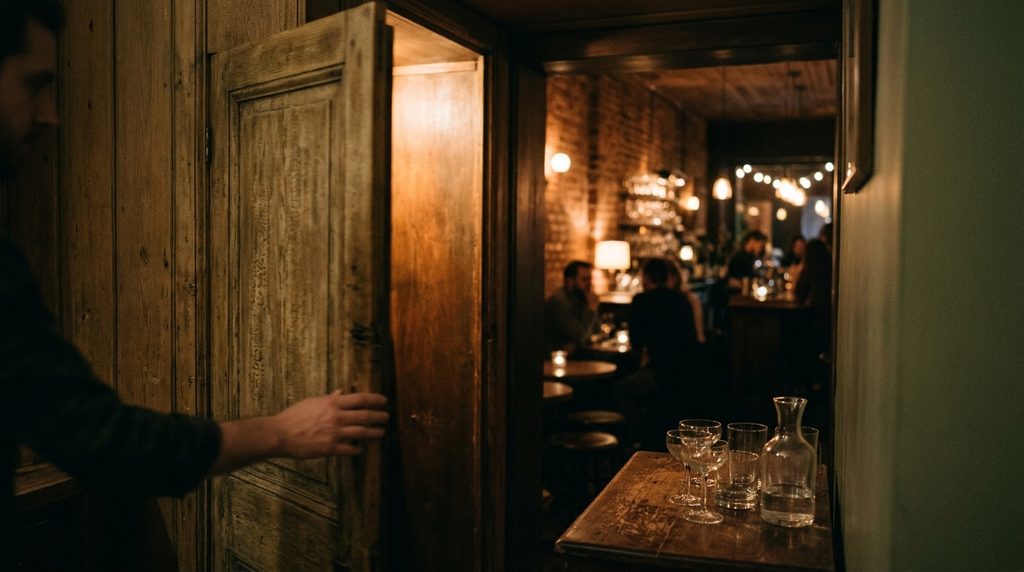
- Baby Far West — Head a few blocks down Notre-Dame to duck into this hidden, 12-seat cocktail saloon concealed inside Le Bar Baby and decompress after taking in the park lore.
- Remains of Saint Ann’s Church — Follow the southwest corridor into Griffintown to trade haunted colonial fountains for ghost church foundations mapped out in park benches.
- Dorchester Square / Old Saint-Antoine Cemetery — Jump on the metro toward downtown to visit another deceptively pleasant city square hiding thousands of unmarked cholera graves beneath the turf.
More weird in Montreal, QC

Good to know
Is the Jacques Cartier atop the park fountain the original 1893 carving?
No. The statue in the park is an all-weather replica installed in the 1990s after decades of rot. The original 1893 wood-and-copper sculpture by Joseph-Arthur Vincent was preserved and relocated inside Place-Saint-Henri metro station in 2001.
Does the water fountain run year-round?
No. Montreal fountain operations are strictly seasonal, typically running only during peak summer months, and this specific mechanical system is frequently dry or turned off for municipal maintenance.
What is the nearest transit stop?
Place-Saint-Henri station on the Orange Line is roughly one block away, making it easy to visit both the park replica and the subterranean original in five minutes.
Why are the Indigenous effigies on the fountain controversial?
The monument frames Indigenous people not with dignity but as stylized, decapitated heads spitting fountain water beneath the feet of a French conqueror—a caricature condemned by Indigenous residents, including Innu surgeon Dr. Stanley Vollant, as an insulting colonial relic.
Plan a visit & invite your people →
Further reading: mtl.org · hauntedmontreal.com · montreal.citynews.ca · globalnews.ca · artpublic.ville.montreal.qc.ca
last checked: 2026-11-20