Entry No. 39 — the Montreal, QC file — filed under: miscellanea
Les Forges de Montréal
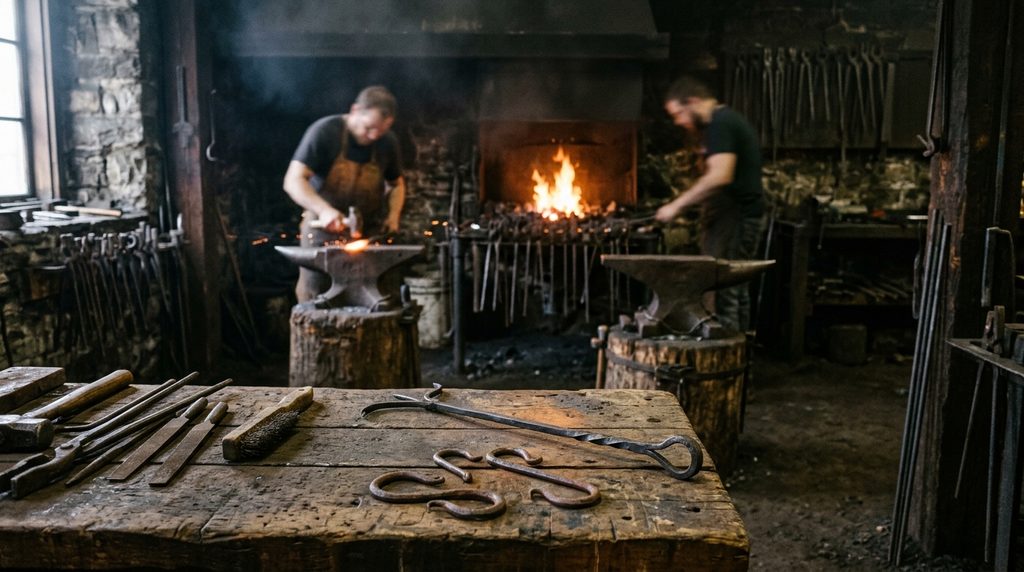
A working blacksmithing school and heritage space with traditional forging classes, demonstrations and tours. Its introductory course covers everyday objects such as hooks and a fireplace poker, and a blacksmith at the school made axes for the Notre-Dame Cathedral restoration.
→ Three more hands-on workshops & classes in Montreal, QC — never the same twice
The story
In 1887, following a disastrous spring deluge that submerged lower Montreal, the city commissioned architects Maurice Perrault and Albert Mesnard to erect the Riverside Pumping Station out of local greystone. Fitted with coal-fired steam pumps, the station spent a century churning stormwater and sewage away from low-lying neighborhoods and into the Saint Lawrence River. When the pumps were finally decommissioned in the late 1980s, the Victorian citadel sat stranded between the port rail lines and the Lachine Canal, slowly rotting until blacksmith Mathieu Collette took over the abandoned shell in 2000 to save the dying art of hand-forging.
Rather than turn the space into a taxidermied museum, Collette established Les Forges de Montréal as an unapologetically functional sanctuary. Coal still burns inside the building, but now it fuels traditional hearths where apprentices and hobbyists hammer glowing iron over an array of antique anvils. The shop's technical pedigree is genuine: when French restorers needed sixty historically accurate hand axes to reconstruct the destroyed timber roof of Paris's Notre-Dame Cathedral after the 2019 blaze, they summoned Collette to lead a crew of young smiths in hand-forging the medieval-style carpentry tools.
The building houses the permanent exhibition 'Savoir-Fer,' detailing the trajectory of metallurgy from the New France era through industrialization. Yet the heart of the operation remains the deafening, sulfur-scented workshop floor, where public demonstrations and introductory forging intensives keep the intangible muscle-memory of 19th-century metalcraft stubbornly alive.
What it's like
Finding the forge means navigating a gritty industrial corridor on Riverside Street; you know you have the right greystone fortress the second you catch the smell of bituminous coal and the metallic chime of hammer strikes. Inside, the light is subterranean and moody, punctuated by the amber flare of the hearths and the hum of forced-air blowers. Weekend guided visits offer a structured view of the museum displays and working forge floors, but full-day courses put you directly at the anvil. If you are taking a class, dress strictly in non-synthetic natural fibers like heavy cotton or wool, lace up real leather boots, and expect to walk out smelling like a coal engine with black slag beneath your fingernails.
The move: Follow the smell of coal and the chime of hammers to the greystone pumping station on Riverside, then take a guided visit past the amber glow of the working forge.
- 📍 Montréal
- 💸 $
- ⚡ Up for anything
- 🌗 Indoors
Where: 227 rue Riverside, Montréal, QC H3C 2H9, Canada
Hours: Added 2026-11-20 — confirm current hours before you go.
Pair it with
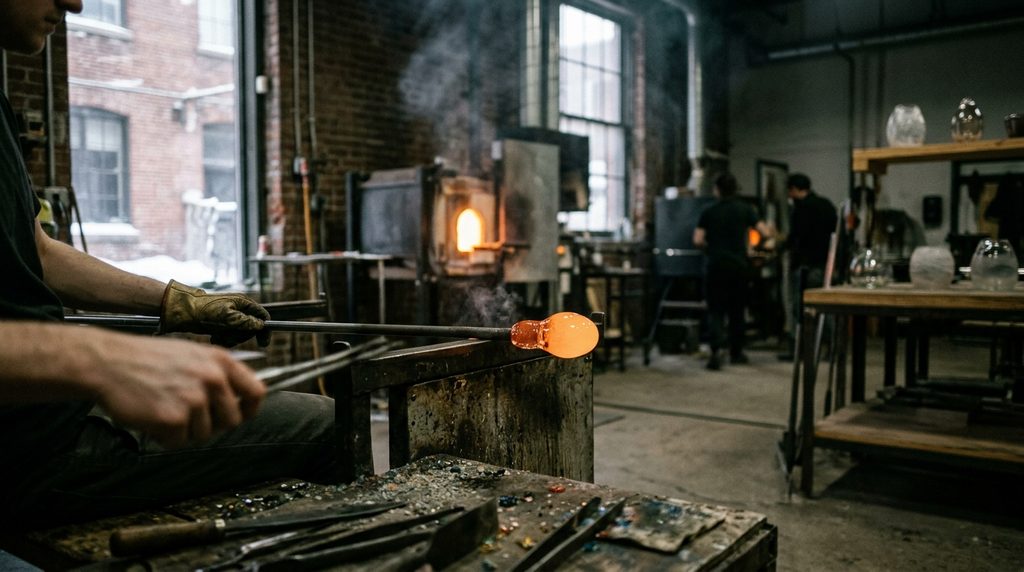
- Espace VERRE — Walk literally next door to swap coal dust, iron anvils, and hammer blows for the 2,000-degree molten furnaces of a glassblowing school.
- Remains of Saint Ann’s Church — Head half a mile into Griffintown to trace the stone foundations of the demolished Irish parish whose community once staffed these surrounding industrial canal works.
- Bassin Peel — Stroll four-tenths of a mile up the canal basin to see how the industrial waterfront transitions from heavy greystone trade to an open-air gathering ground.
More weird in Montreal, QC


Good to know
Can I just walk in, or do I need a reservation?
Guided tours and demonstrations require booking in advance through their website, as the building functions primarily as an active training forge with restricted workshop access.
What do beginners make in the introductory course?
Introductory workshops focus on fundamental hand techniques like drawing out, bending, and punching, usually yielding functional household pieces such as hooks and a fireplace poker.
What are the safety and dress requirements for courses?
You must wear sturdy, closed-toe leather footwear and clothing made of 100% natural fibers (cotton, denim, or wool); synthetic fabrics like nylon or polyester will melt if hit by stray sparks.
What was the building before it was a forge?
It was the Riverside Pumping Station, constructed in 1887 by architects Maurice Perrault and Albert Mesnard to manage city floodwaters until its decommissioning in the late 1980s.
Plan a visit & invite your people →
Further reading: Official site · Facebook · mtl.org · globalnews.ca · cbc.ca
last checked: 2026-11-20