Entry No. 69 — the Pensacola & Emerald Coast file — filed under: miscellanea
Chautauqua Hall of Brotherhood
A historic landmark situated along a rare, naturally circular spring lake, commemorating the town's role in the 19th-century Chautauqua educational movement.
→ Three more unusual museums & collections in Pensacola & Emerald Coast — never the same twice
The story
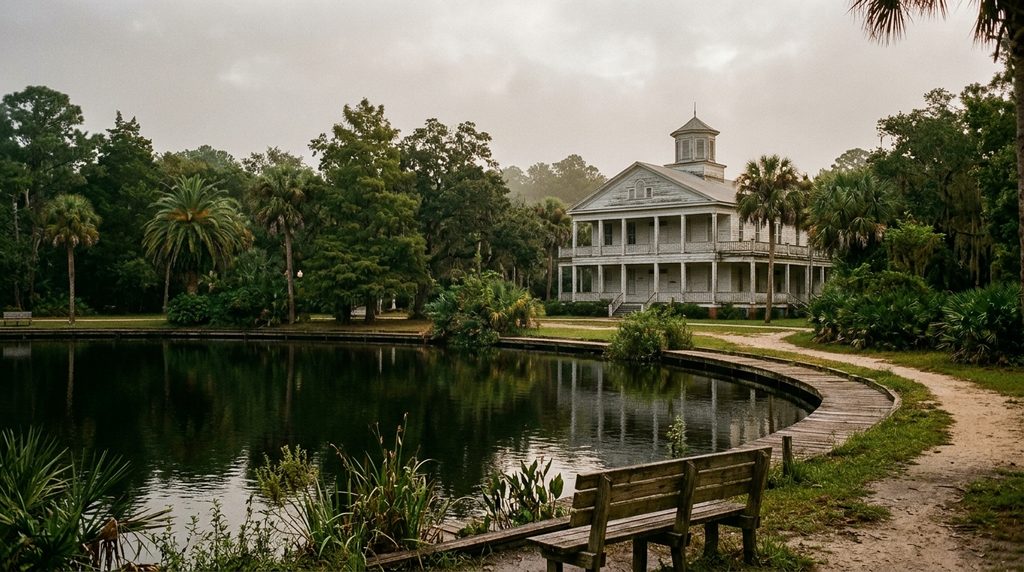
In 1909, civic boosters in DeFuniak Springs decided that an intellectual winter utopia in the piney Panhandle needed an architectural pantheon. They built the Chautauqua Hall of Brotherhood as a massive wooden echo of the U.S. Capitol, fronted by an imposing colonnade and flanked by a 4,000-seat auditorium designed to hold double the town's entire year-round population. Every winter, thousands of Victorian-era travelers stepped off the passenger trains of the Pensacola & Atlantic Railroad into the self-proclaimed 'Winter Assembly in the Land of Summer,' trading northern blizzards for art classes, choir performances, and political lectures by three-time presidential candidate William Jennings Bryan.
The original assembly ran until the late 1920s, but the building's strangest chapter unfolded on September 23, 1975. When Hurricane Eloise made landfall along the Panhandle, a storm-spawned tornado tore directly through the auditorium. The rear wall collapsed, the heavy center trusses buckled, and roughly a third of the roof was obliterated in minutes. Incredibly, the storm spared the grand two-story western entrance hall and its classical columns. Engineers declared the cavernous back hall structurally unsalvageable, disaster funds cleared the wreckage, and the town was left with a monumental neoclassical facade missing its body.
Since then, decades of stubborn grassroots fundraising and Florida historic preservation grants have stabilized the surviving entrance structure. Workers have restored the heart-pine flooring, repaired rot in the columned portico, and renewed the second-floor beadboard ceilings. It now stands as one of northern Florida's most surreal architectural survivors: a white neoclassical temple stranded at the water's edge of a spring lake, guarding an auditorium that vanished into the pines half a century ago.
What it's like
Circle Drive is remarkably quiet outside of festival weekends, with the hall's massive white portico casting sharp reflections across the lake. The building serves civic roles and event functions, so walking inside depends entirely on municipal schedules, but the exterior alone justifies the detour. Be sure to walk around the perimeter to the eastern rear: you can clearly see the abrupt, truncated seam where four thousand auditorium seats used to jut into the trees before Hurricane Eloise tore them away.
The move: Follow Circle Drive together to catch the white portico’s sharp reflection in the naturally round lake, then round the hall’s eastern side to see where your wooden Capitol double comes to an abrupt stop.
- 📍 DeFuniak Springs
- 💸 $
- ⚡ Up for anything
- 🌗 Indoors
Where: 95 Circle Drive, DeFuniak Springs, FL 32433
Hours: Added 2026-11-17 — confirm current hours before you go.
Pair it with
- Fountain of Youth & Lake DeFuniak — The hall sits right on the edge of this spring lake, where you can walk the 0.7-mile shoreline loop past original Victorian cottages from the assembly era.
- Hotel DeFuniak — Walk three blocks into town to visit this 1920 boutique hotel, built to accommodate travelers visiting the town's cultural circuit.
- Sunbright Inn — Pair your visit with a stop at this nearby 1886 Queen Anne mansion, once home to former Florida Governor Sidney J. Catts.
More weird in Pensacola & Emerald Coast

Good to know
What happened to the missing half of the building?
A tornado during Hurricane Eloise struck on September 23, 1975, blowing away the roof and crushing the 4,000-seat wooden auditorium. The wreckage was subsequently demolished for safety, leaving only the two-story colonnaded entrance hall standing.
Can you go inside?
Access varies. The building hosts public civic meetings, Walton County Chamber functions, and seasonal exhibits. When open during standard weekday hours, visitors can typically step inside the foyer to view historic photos and original architectural details.
When does the Florida Chautauqua Assembly take place?
The modern revival of the assembly is held annually in late January, bringing educational seminars, historical reenactments, and art programs back to the hall and the surrounding grounds.
Is there an admission fee to view the building?
No. Viewing the hall from Circle Drive and exploring the surrounding lakeyard park is entirely free and accessible day and night.
Plan a visit & invite your people →
Further reading: worldatlas.com · defuniaksprings.net · apps.flheritage.com · historic-structures.com · Official site
last checked: 2026-11-17