Entry No. 27 — the Pensacola & Emerald Coast file — filed under: miscellanea
Gulf Coast Kiln Walk
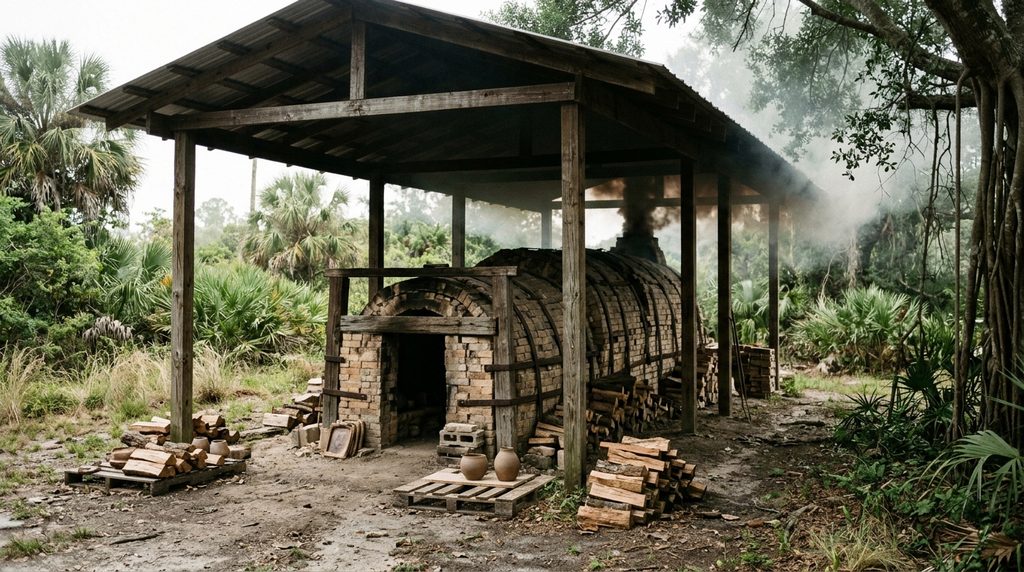
This open-air cultural site is home to the Gulf Coast's massive, 32-foot wood-fueled historical 'Anagama' ceramic kiln.
→ Three more weird outdoor & roadside oddities in Pensacola & Emerald Coast — never the same twice
The story
In 2000, potters Marty, Brenda, and Jason Stokes realized that anyone on the northern Gulf Coast itching to fire ceramics in a traditional wood kiln was looking at a twelve-hour drive in any direction. Rather than haul their work to the hills of Georgia or North Carolina, the family behind Holley Hill Pottery carved out room in the scrub oak along Buckeye Drive and founded the Gulf Coast Kiln Walk Society to build one in their backyard. In August 2004, renowned Arizona wood-fire artist Don Reitz and ceramic sculptor Brian Harper arrived on site to build a 32-foot Anagama—a Japanese-style 'cave kiln'—mortared together with the help of community volunteers and labor from the Santa Rosa County Sheriff's Department.
Firing an Anagama isn't casual studio work; it is an endurance trial. The crew spends four days stacking upwards of 800 raw, unglazed pots inside the brick throat, working strictly back to front, before sealing the opening shut. Once lit, volunteer crews monitor the belly around the clock in rotating shifts for six continuous days, steadily feeding cordwood into the flames until temperatures climb past 2,300 degrees Fahrenheit. There are no synthetic glazes involved; the earthy, vitrified patterns on the finished pots come entirely from swirling fly ash, intense heat currents, and direct flame lick marks that deposit across the clay before the structure is choked and left to cool for nearly two weeks.
To deepen the eccentricity of the lot, the society also acquired and relocated the state's only reconstructed, fully functional 1940s Southern Altered Groundhog kiln, hauling it south from the farming town of Jay in 2009. Sitting quietly under metal pole sheds behind the Stokes family's retail showroom, the two kilns make Holley an unlikely beacon for massive, smoke-choked historical pyro-craft.
What it's like
Turn into the unpaved lot off Buckeye Drive and you'll find Holley Hill Pottery's front showroom stocked with local coastal stoneware, while the massive brick kilns rest quietly under open-air pole sheds out back. On a normal Saturday visit, the vibe is low-key, unhurried, and self-guided—you can wander right up to the kiln mouths, inspect the scorched firebrick, and chat with whoever is working the studio. The real spectacle happens once a year on the second Saturday in February during the WoodStoke Festival: you can join a human bucket brigade passing warm, freshly fired pots hand-to-hand out of the Anagama's belly, then buy a bowl made of local clay to sample chili and seafood cooked up by neighbors.
The move: Browse the coastal stoneware in the showroom, then head out back and peer into the scorched brick mouth of the 32-foot wood-fired cave kiln together.
- 📍 Santa Rosa County
- 💸 Free
- ⚡ Up for anything
- 🌗 Outdoors
Where: 7507 Buckeye Dr (Buckeye Road), Holley / Navarre, Santa Rosa County, FL 32566
Hours: Added 2026-11-17 — confirm current hours before you go.
Pair it with
- Emerald Coast Wildlife Refuge — Just two miles south on Highway 87, swap heavy wood-smoke craftsmanship for one-way observation windows into a working native wildlife hospital.
- Glow Paddle — Cap an afternoon studying brick kilns and ash glazes with an after-dark cruise across Santa Rosa Sound in 100% transparent, LED-illuminated kayaks.
- Arcadia Homestead — Head north toward Milton to trace more early Santa Rosa County industry along historic mill races and timber ghost trails.
More weird in Pensacola & Emerald Coast
Good to know
When are the kilns fired?
The 32-foot Anagama kiln requires round-the-clock stoking and several cords of wood, so firings are held only for dedicated workshops and the annual WoodStoke festival in early winter.
Is it free to visit the kilns?
Yes. Touring the open-air kiln grounds and browsing the Holley Hill Pottery gallery is free, with donations accepted to support the society's ceramic arts center campaign.
What is the difference between the two kilns on site?
The 32-foot Anagama is a Japanese-style cave kiln built in 2004 for natural wood-ash glazing, while the smaller groundhog kiln is a reconstructed 1940s brick kiln salvaged from Jay, Florida, representing traditional Southern utilitarian pottery methods.
Can visitors take part in the kiln unloading?
Yes, during the annual WoodStoke festival in February, the public is invited to step into the line and help potters pass newly unloaded pieces hand-to-hand from the chamber to the catalog tables.
Plan a visit & invite your people →
Further reading: santarosa.fl.gov · ballingerpublishing.com · uwf.edu · Official site
last checked: 2026-11-17