Entry No. 48 — the Pensacola & Emerald Coast file — filed under: miscellanea
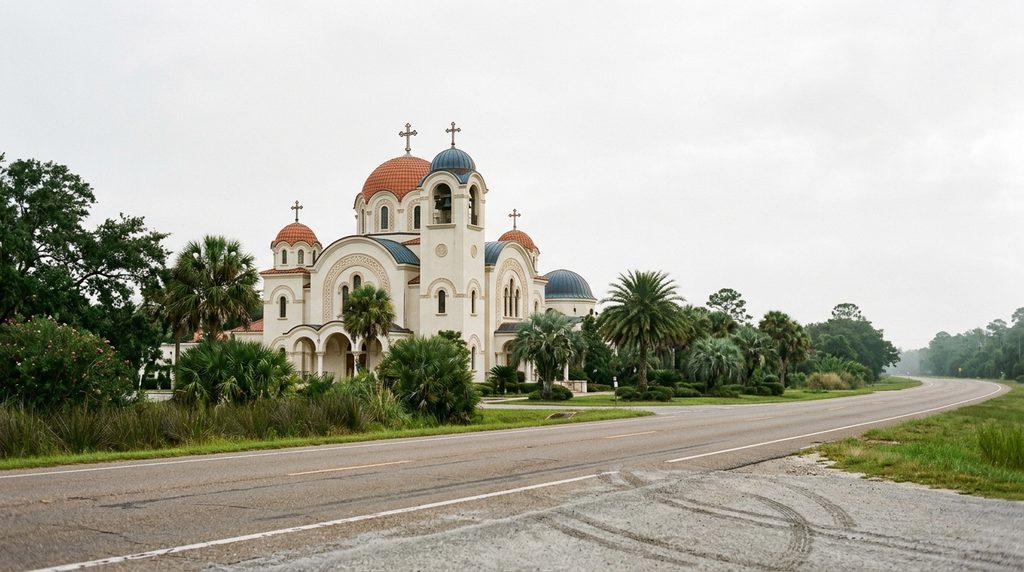
Malbis Memorial Church
A distinctive, eye-catching Greek Orthodox church along Alabama Highway 181 that stands out as a unique roadside landmark on Baldwin County's Eastern Shore.
→ Three more weird outdoor & roadside oddities in Pensacola & Emerald Coast — never the same twice
The story
In 1906, a former Greek Orthodox monk named Antonios Markopoulos—who anglicized his name to Jason Malbis after a stint in Chicago—arrived in rural Baldwin County with his associate William Papageorge and bought 120 acres of cutover timberland for five dollars an acre. That modest plot gradually became the Malbis Plantation: a cooperative, self-sufficient colony of Greek immigrants that eventually spanned thousands of acres, operating its own farms, dairy, cannery, and the wildly lucrative Malbis Bakery across the bay in Mobile.
Malbis traveled back to Greece on family business just before World War II and became trapped there by the conflict, dying in Athens in 1942. His dying wish was explicit: bring his remains back to Alabama and erect a proper Greek Orthodox church on the plantation. Two decades later, plantation president Sam George Papas sold off the Mobile commercial bakery to bankroll the construction, commissioning Mobile architecture firm Frederick C. Woods and Associates to build a Byzantine Revival monument inspired by Athens' Church of Ayia Paraskevi. Malbis's remains were disinterred from Greece and entombed in a marble crypt just to the right of the iconostasis.
Because of its memorial charter, the church has never had a conventional weekly parish, and rather than answering to the regional American archdiocese, it was placed under the direct authority of the Ecumenical Patriarchate of Constantinople. Inside, three master iconographers flown in from Greece spent nine months covering virtually every square inch of wall and dome with more than 150 biblical frescoes, framed by red marble Corinthian columns and a hand-carved Athenian marble iconostasis. It stands along the highway as an improbable reliquary from an immigrant utopian venture that modern suburban development has nearly surrounded.
What it's like
Cruising along Alabama Highway 181 through Daphne's strip centers and subdivisions, the church's red brick masonry, flanking towers, and central Byzantine dome look like an architectural mirage. Because there is no standard Sunday congregation, the front doors are frequently shut tight outside of limited daytime hours (historically Tuesday through Thursday from 10 a.m. to 4 p.m.) or monthly liturgies. If a foundation caretaker is on the grounds, they will often unlock the sanctuary, switch on the overhead lighting, and let you take in the echoing vault in complete quiet under the gaze of the dome's Pantokrator. Call the church office ahead of time to confirm the building will actually be open, and treat the interior with reverence—Jason Malbis's tomb is right beside the altar screen.
The move: Pull off Highway 181 together for a closer look at the red brick, then tilt your heads back to take in the Byzantine dome between the towers.
- 📍 Daphne, AL
- 💸 Free
- ⚡ Up for anything
- 🌗 Outdoors
Where: 29300 Alabama Highway 181 (AL-181), Daphne, AL 36526
Hours: Added 2026-11-17 — confirm current hours before you go.
Pair it with
- Styx & Bones Oddities Cafe — Trade Byzantine religious icons for coffee, oddities, and taxidermy displays located twelve miles east down the highway in Robertsdale.
- Bamahenge — Continue an excursion into out-of-place roadside architecture by driving south toward Elberta to find Mark Cline's full-scale fiberglass Stonehenge tucked in the coastal woods.
- Dinosaurs in the Woods — Double up on Baldwin County weirdness by checking the tree canopy near Barber Marina for life-sized prehistoric creatures hiding just off the gravel paths.
More weird in Pensacola & Emerald Coast
Good to know
Is Malbis Memorial Church an active parish?
No. The church was established without a regular weekly congregation and functions primarily as a consecrated memorial and stavropegial monastery, opening occasionally for special events, weddings, and monthly services.
Who is buried inside the church?
Plantation founder Jason Malbis. After he died in Athens during World War II, his remains were eventually repatriated to Alabama and entombed within a marble crypt located to the right of the iconostasis.
When is the building open for visitors?
Visiting hours have traditionally run Tuesday through Thursday from 10:00 AM to 4:00 PM, though open access depends on caretaker availability. Calling the church foundation at 251-626-6739 in advance is the safest way to ensure the doors will be unlocked.
What makes the interior art significant?
Three Greek master artists spent nine months painting more than 150 hand-rendered fresco scenes depicting scripture across the walls and central dome, all centered around a white marble iconostasis carved in Athens.
Plan a visit & invite your people →
Further reading: professionalsoutherner.com · alabamaliving.coop · encyclopediaofalabama.org · sah-archipedia.org · Wikipedia · alabama.travel
last checked: 2026-11-17