Entry No. 47 — the San Angelo & Abilene file — filed under: miscellanea
Hayrick and Hayrick Cemetery Marker
A ghost-town account names both the Hayrick Cemetery Marker and a county-seat marker, linking the site to the former settlement’s history.
→ Three at a time, never the same twice — explore weird San Angelo & Abilene
The story
When Coke County was carved out of Tom Green County in the spring of 1889, Hayrick was its undisputed center. Named for the solitary, hay-mound-shaped mesa rising just north of the flatlands, the town started with twenty-five settlers, a post office, and the county's first newspaper, the Hayrick Democrat (soon rechristened the Rustler). It immediately captured the designation of county seat. But holding political power on the West Texas frontier was a full-contact sport, and southern ranchers along the Colorado River were not pleased about trekking out to an arid mesa with a notoriously weak water supply.
Hayrick’s tenure as the seat of local government lasted barely two years, punctuated by violence: two successive log courthouses burned to the ground, both widely suspected to be arson jobs meant to purge land records and cripple municipal operations. Sensing an opening, rival land promoters R.E. Cartledge and L.B. Harris laid out the downstream settlement of Robert Lee and began dangling free town lots to any Hayrick resident willing to defect. In the bitter 1891 county-seat election, Robert Lee snatched the title by a razor-thin margin of forty-eight votes.
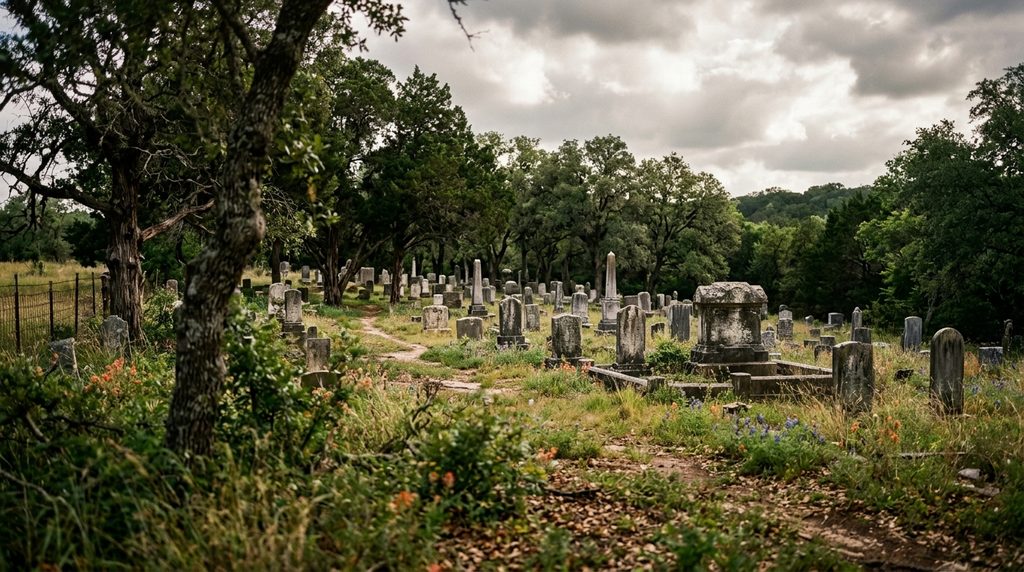
Hayrick didn't just decline; it unraveled in weeks. The population dismantled their homes, hauled the salvaged county records south, and even relocated Hayrick Masonic Lodge 696 into Robert Lee. Within a few seasons, the structures disappeared back into the mesquite brush, leaving nothing behind except the pioneer burial ground and a 1936 Texas Centennial granite marker to prove a county capital ever stood in the shadow of the mountain.
What it's like
Reaching the site requires rolling east from Robert Lee along State Highway 158 and turning north onto unpaved, rutted caliche roads where cell signal fades to a bar or two. At the end of the line, you'll encounter a wire gate opening onto weathered stone headstones scattered across native scrub, with the distinct silhouette of Hayrick Mountain dominating the horizon. The site is entirely exposed with zero shade, running water, or facilities; wear thick boots for ground briars and West Texas rattlesnakes, and leave any ranch gate exactly as you found it.
The move: Follow the rutted caliche roads to the wire gate, read the cemetery marker together, then pick out weathered headstones in the scrub with Hayrick Mountain on the horizon.
- 📍 Hayrick area
- 💸 $$
- ⚡ Up for anything
- 🌗 Indoors
Where: No street address — Hayrick Cemetery (Hayrick site) at approx. 31.954863, -100.395097 (about 8 miles NE of Robert Lee, Coke County, TX; reached from FM 158/Hayrick Road); no formal street address
Hours: Added 2026-11-17 — confirm current hours before you go.
Pair it with
- 1886 Olde Park Hotel — If Hayrick's burned courthouses whet your appetite for rough 1880s frontier bureaucracy, this Ballinger property took turns as a county courthouse, school, and bordello.
- Gonzalez Restaurant — After kicking through the dry caliche of Coke County, head to this Ballinger dining room known for Tex-Mex and sightings of a resident spectral cowboy.
- 1909 Advanced Rumley Tractor — Pair a vanished 1880s ghost town with another piece of turn-of-the-century West Texas frontier muscle resting on the highway shoulder in Miles.
More weird in San Angelo & Abilene
Good to know
Where is the Hayrick site located?
The cemetery and markers sit roughly eight miles northeast of Robert Lee in Coke County, Texas, reached by taking Highway 158 east and turning north onto unpaved Hayrick Road.
What physical remains of Hayrick can you see today?
None of the town's original buildings survived. Today, the location consists of Hayrick Cemetery, headstones dating to the late 1800s, and a pair of historical markers, including a 1936 Texas Centennial monument commemorating the first county seat.
Why was the town abandoned so fast?
After two courthouse fires and chronic water shortages, southern Coke County ranchers forced a new election in 1891. When Robert Lee won, rival town promoters gave away free parcels of land, causing virtually all of Hayrick's residents to pack up their belongings and move.
Are there visiting hours or admission fees?
There are no fees or staffed gates. The cemetery is accessible during daylight hours, but visitors must respect the burials and avoid trespassing onto surrounding private ranch land.
Plan a visit & invite your people →
Further reading: siouxsue.blogspot.com · tshaonline.org · atlas.thc.texas.gov · hmdb.org · texasescapes.com
last checked: 2026-11-17