Entry No. 31 — the Sierra Vista & Fort Huachuca file — filed under: miscellanea
Fry Pioneer Cemetery
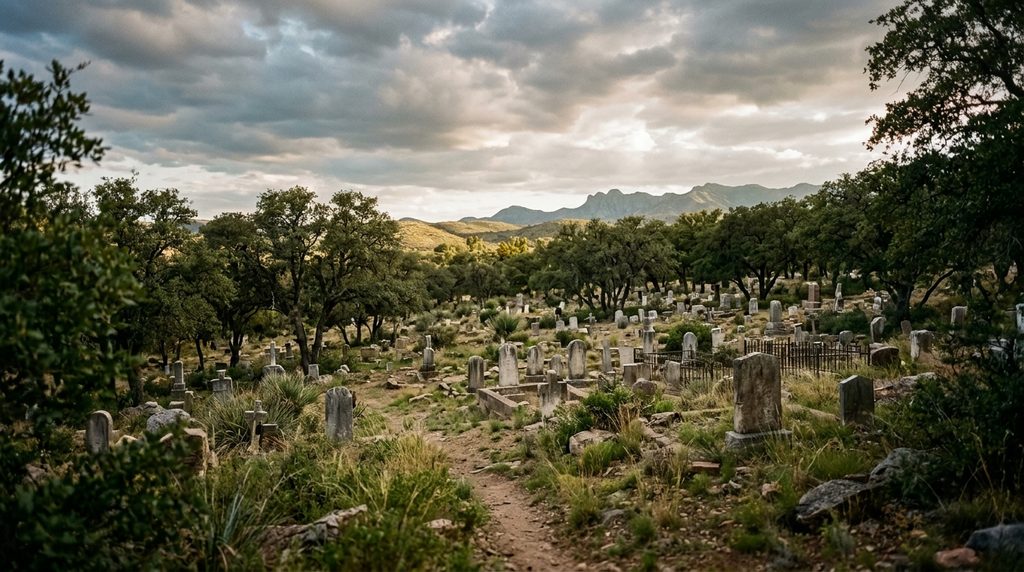
A historic burial ground preserving the morbid early pioneer history of Sierra Vista from when the community was originally known as Fry.
The story
Before Sierra Vista took on its sanitized chamber-of-commerce moniker in 1956, the whole dusty settlement went by Fry, named after homesteader Oliver Fry. On Christmas Day in 1919, Fry's 49-year-old wife, Elizabeth 'Lizzie' Ruth Cathcart Fry, died. He buried her on the eastern corner of their homestead parcel, an act that turned the soil into the Fry Pioneer Cemetery. Today, that half-acre dirt rectangle is the sole surviving physical fragment of the original Fry homestead. The family general store burned to the ground in 1961, and their ranch house went up in flames in 1991, leaving only this pocket of graves behind.
The cemetery's sharpest secret isn't who is remembered, but who was paved over. Inside the perimeter fence, a three-foot brick wall encloses the tidy Fry family enclosure, housing thirteen marked graves including Oliver himself, who lasted until age 88 before joining Lizzie in 1959. Outside that brick rectangle lies a bare flat of caliche containing more than 200 documented bodies—fewer than two dozen of which have a standing headstone or stone border. These are the graves of the Mexican and Yaqui families whose labor built the town alongside the homesteaders. In fact, early burials were so informal that historical surveys discovered human remains extending westward directly beneath the asphalt of commercial parking on 6th Street.
When Sierra Vista incorporated in 1956, the Fry clan refused to join, marooning their property in an unincorporated island of Cochise County known as Fry Township, completely enveloped by the new city. The city eventually acquired the land and had it placed on the National Register of Historic Places in 2009, but nobody has tried to manicure it into a manicured lawn. There are no ornamental hedges and no visitor facilities—just bare desert dirt, native mesquite scrub, and nearly a century of neglected borderland history.
What it's like
Stashed immediately behind commercial buildings north of Fry Boulevard, the cemetery looks less like a historic site and more like an abandoned neighborhood plot surrounded by 1960s chain-link. Parking is street-side along North 7th Street or in neighboring commercial spaces. There are no paved paths or interpretive signs; you are walking on uneven caliche and desert gravel where subtle depressions in the earth indicate unmarked graves. The perimeter gate is routinely padlocked to protect the delicate ground, though the entire half-acre and the low-walled Fry family plot are fully visible from the fence line. Wear sturdy closed-toe shoes to handle the goatheads and loose stone.
The move: Step off North 7th Street onto the uneven caliche of this forgotten half-acre cemetery, tracking down the brick-walled plot where homesteaders Oliver and Lizzie Fry rest behind dusty commercial storefronts.
- 📍 Sierra Vista
- 💸 $$
- ⚡ Up for anything
- 🌗 Indoors
Where: 112 N 7th St, Sierra Vista, AZ 85635
Hours: Added 2026-11-18 — confirm current hours before you go.
Pair it with
- Sierra Vista Historical Society & Henry F. Hauser Museum — The Hauser Museum curates the oral histories, family photographs, and preservation research that explain who actually lies beneath the unmarked dirt at Fry.
- Fort Huachuca Museum & Old Post Cemetery — Head straight west down Fry Boulevard onto the post to contrast Fry's raw civilian dust with the regimented rows of the 1877 Old Post Cemetery.
- The Hoppin’ Grapes Wine & Craft Beer Bar — Just two miles east on Fry Boulevard, this craft beer and Arizona wine bar provides cold air-conditioning and a good seat after scouring forgotten graves.
More weird in Sierra Vista & Fort Huachuca
Good to know
Can you walk inside the cemetery anytime?
The chain-link gate is frequently locked to protect unmarked graves from foot traffic and vandalism, but the entire half-acre plot and inner brick memorial wall are clearly visible from the street-facing fence line on North 7th Street.
Why are so many graves unmarked?
Most of the roughly 200 people buried here between 1919 and 1958 were working-class Mexican and Yaqui residents whose families could only afford wooden crosses or fieldstone rings, which rotted away or scattered over decades of desert weather.
Are there really graves outside the cemetery fence?
Yes. Historical surveys confirmed that unmarked burials extend west beneath commercial parking on 6th Street and east toward 7th Street, prompting Cochise County to place protective burial ordinances on the bordering parcels.
Are guided tours ever offered?
The Henry F. Hauser Museum and the Sierra Vista Historical Society periodically host seasonal walking tours and living-history evenings, such as their 'Dusk with the Dead' events.
Plan a visit & invite your people →
Further reading: Facebook · Wikipedia · myheraldreview.com · npgallery.nps.gov
last checked: 2026-11-18