Entry No. 29 — the Tacoma & South Sound file — filed under: miscellanea
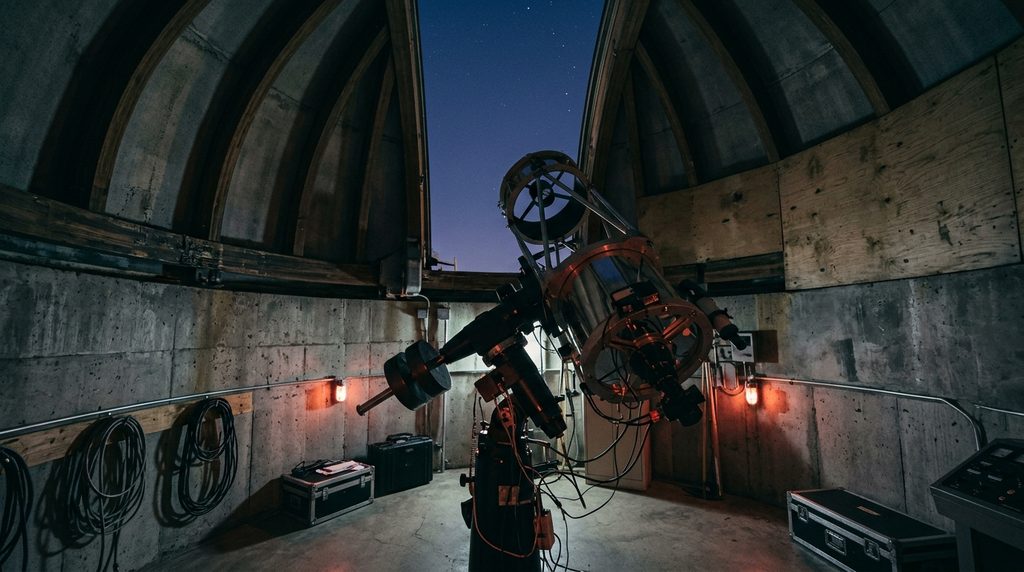
W.M. Keck Observatory (Pacific Lutheran University)
Located within the PLU Physics Department, this university observatory periodically opens its doors to the public for evening stargazing and student-led tours.
→ Three more after-dark & night-sky spots in Tacoma & South Sound — never the same twice
The story
Most people hear "Keck Observatory" and picture the twin ten-meter giants on Maunakea in Hawaii. You probably didn't know Parkland has its own official Keck outpost—Minor Planet Center observatory code 917—tucked quietly behind Pacific Lutheran University's Rieke Science Center and Olson Gym. It was built with a $500,000 grant from the very same Los Angeles-based W.M. Keck Foundation in 1998, seeing first light in 2000.
Inside the compact white dome sits a 16-inch Meade LX200 Schmidt-Cassegrain reflecting telescope synchronized with an automated tracking dome. This isn't a passive museum relic with an audio tour. It is an active working lab where PLU physics students mount CCD cameras and 3D-printed Bahtinov masks to track asteroid trajectories, measure the drift of Jupiter's Great Red Spot, and map gaps in Saturn's rings.
Because it functions primarily as an undergraduate research station, the observatory operates largely off the radar. Public access happens on an irregular basis—chiefly through summer open houses hosted by student researchers or co-organized with the Tacoma Astronomical Society after campus events like Jazz Under the Stars. If you don't check campus physics bulletins, you'd never know the door was open.
What it's like
Follow the red-lit pathway behind the science building; the low-wavelength light keeps your eyes dark-adapted before you enter. The dome interior holds only about 12 people at a time, so on busy open house nights, student researchers funnel visitors through in ten-minute shifts. While waiting your turn, Tacoma Astronomical Society volunteers often set up personal tripods and secondary scopes on the surrounding lawn. Dress significantly warmer than the ambient weather suggests: the dome cannot be heated without creating thermal air turbulence that ruins the telescope's focus.
The move: Follow the red-lit path behind the science building on an open house night, then squeeze into the little white dome for your ten-minute turn at the 16-inch telescope.
- 📍 Tacoma
- 💸 $
- ⚡ Low-key
- 🌗 Outdoors
Where: 12180 Park Ave S, Parkland (Tacoma), WA 98447
Hours: Added 2026-11-17 — confirm current hours before you go.
Pair it with
- Pierce College Science Dome — Pair physical eyepiece viewing at PLU with Pierce College's 38-foot digital projection dome for a complete South Sound astronomy circuit.
- The Church Cantina — Warm up after shivering on the Parkland lawn with Cuban sandwiches and gothic dive decor along South Tacoma Way.
- B&I Public Marketplace — Kill a couple of daylight hours browsing oddities and arcade relics three miles north before the sun goes down.
More weird in Tacoma & South Sound

Good to know
How much does it cost to attend an open house?
Admission is free, and parking in the campus lots directly surrounding the science buildings is also free during public evening events.
When is the dome actually open to visitors?
There are no set weekly operating hours. Public viewings are scheduled sporadically, primarily on select Thursday evenings during mid-summer research terms or tied to campus music events.
What happens if the weather is cloudy?
The 16-inch reflector cannot penetrate cloud cover. While indoor tours and astronomy Q&As may still proceed, live sky viewing is cancelled if the South Sound sky is socked in.
What gear is inside the observatory?
The main instrument is a 16-inch Meade Schmidt-Cassegrain reflector mounted beneath a motorized rotating dome, supported by digital CCD sensors and planetary imagers.
Plan a visit & invite your people →
Further reading: plu.edu · sbnmpc.astro.umd.edu · projectpluto.com · cleardarksky.com · pluastronomyresearch.weebly.com
last checked: 2026-11-17