Entry No. 33 — the Denver file — filed under: history walk
Highland Park / Scottish Village Historic District
“standing in a tiny piece of a failed Scotland and never know it”
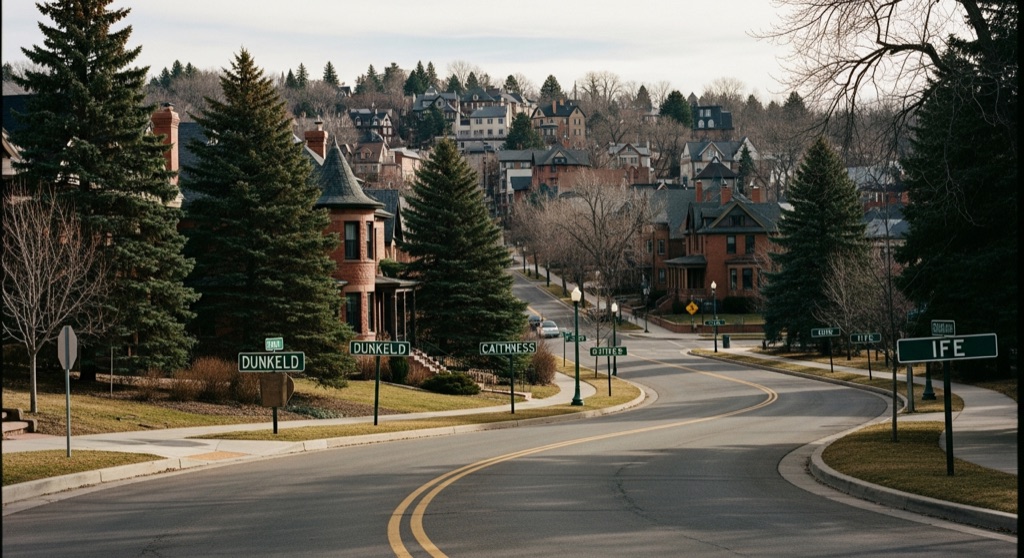
Denver is a relentless grid until you turn off Zuni near 32nd and the streets suddenly start curving, with names like Argyle, Dunkeld, Caithness and Fife. In 1874 Palmer and Bell tried to build an entire Scottish-themed suburb here because the bluffs reminded Bell of the Highlands; the grand plan collapsed and only this 23.8-acre fragment survived, now on the National Register. You can be standing in a tiny piece of a failed Scotland and never know it.
→ Three more haunted places & dark-history spots in Denver — never the same twice
The story
In 1874, General William Jackson Palmer and his English business partner Dr. William A. Bell looked out over the bluffs rising west of the South Platte River and decided Denver’s rigid street grid was far too uncivilized. Bell convinced himself the rolling bluffs resembled the Scottish Highlands, prompting the duo to plan an ambitious picturesque suburb named Highland Park. Modeled after romantic, winding enclaves like Chicago's Riverside, their layout ditched right angles entirely for serpentine lanes that hugged the natural contours of the hill.
The grand highland vision quickly fractured. Financial strain and early transit obstacles across the river valley halted development, and standard grid-aligned city growth swallowed up the surrounding land. Only a tiny 23.8-acre pocket tucked behind West 32nd Avenue and Zuni Street survived intact. Listed on the National Register of Historic Places in 1985, this pocket remains the last surviving footprint of Palmer and Bell's romantic suburb experiment along the Front Range.
Step past the storefronts on Zuni and the straight lines disappear into narrow lanes bearing Scottish names: Argyle Place, Caithness Place, Dunkeld Place, and Fife Court. Instead of grand castles, the streets are lined with a dense, quiet mix of late-19th-century brick cottages, duplexes, and triplexes. You are standing inside a slice of a failed Scottish retreat, completely hidden from the rest of North Denver by a single block of modern commerce.
What it's like
Turn off Zuni Street near West 32nd Avenue and watch the grid break down into curving, shaded lanes. The entire district covers under 24 acres, making a slow loop a brief 20-to-30-minute walk on foot. Park along West 32nd Avenue or a nearby side street and explore during daylight to read the historic street signs and spot cottage details under the mature tree canopy. Remember that these are lived-in residential homes, so stay strictly on public sidewalks and keep noise low before heading back out to the cafes along 32nd Avenue.
The move: Do a 20-30 minute slow walk through the curving lanes off Zuni, hunting the Scottish street signs and the oldest houses, then reward yourselves at a 32nd Ave cafe a block away.
📍 Before you go The district hides behind the Zuni Street and West 32nd Avenue storefronts in the Highlands — turn in off Zuni near 32nd and watch for the lanes that stop running straight (Argyle, Caithness, Dunkeld, Fife). It's tiny, under 24 acres, so the whole loop is a short stroll. Park on 32nd or a side street and walk in. Go in daylight to read the signs and house details; the old trees make it leafier and prettier from late spring into fall. This is a lived-in neighborhood, so stick to the public sidewalks and keep it quiet. Reward the walk at a 32nd Avenue cafe a block away, with more Highlands dining a few blocks east.
- 📍 Highlands
- 💸 Free
- ⚡ Low-key
- 🌗 Outdoors
Where: Off Zuni St near W 32nd Ave, Denver, CO 80211 (district roughly bounded by W 32nd Ave, Zuni St, Dunkeld Pl and Clay St; look for Argyle Pl, Caithness Pl, Dunkeld Pl, Fife Ct)
Hours: Public streets, walkable anytime; daylight is best for spotting street signs and house details. Residential, so keep it low-key.
Pair it with
- Lumber Baron Inn & Gardens — Walk six blocks west into Potter-Highlands to contrast Palmer and Bell's failed romantic suburb with a restored 1890 Queen Anne mansion that carries its own grim 1970s double-murder history.
- Botanica Yemaya — Head four blocks west to swap Victorian urban planning for a floor-to-ceiling shop stocked with devotional candles, oils, and Afro-Cuban spiritual supplies.
- Old Elitch Carousel Dome (with floor labyrinth) — Head a mile northwest to see another surviving piece of early Highland history—a 1926 12-sided carousel pavilion that outlasted the original amusement park.
More weird in Denver

Good to know
Where is the Scottish Village located?
It sits tucked directly behind the commercial storefronts in Denver's Highlands neighborhood, roughly bounded by West 32nd Avenue, Zuni Street, Dunkeld Place, and Clay Street.
Are there actual Scottish ruins or castles here?
No. The Scottish connection stems from the street names, the curved layout designed to mimic Scottish hill villages, and the late-19th-century residential cottages.
How long does a visit take?
Plan for a 20-to-30-minute self-guided walk through the short, curving streets before heading to a nearby 32nd Avenue cafe.
Is there an entry fee or set schedule?
No. The district consists of public city streets and private homes, making it free and accessible anytime, though daylight is best for seeing details.
Plan a visit & invite your people →
Further reading: historycolorado.org · Wikipedia · cpr.org · npgallery.nps.gov
last checked: 2026-06-07