Entry No. 26 — the El Paso & Fort Bliss file — filed under: miscellanea
Casa de Azucar
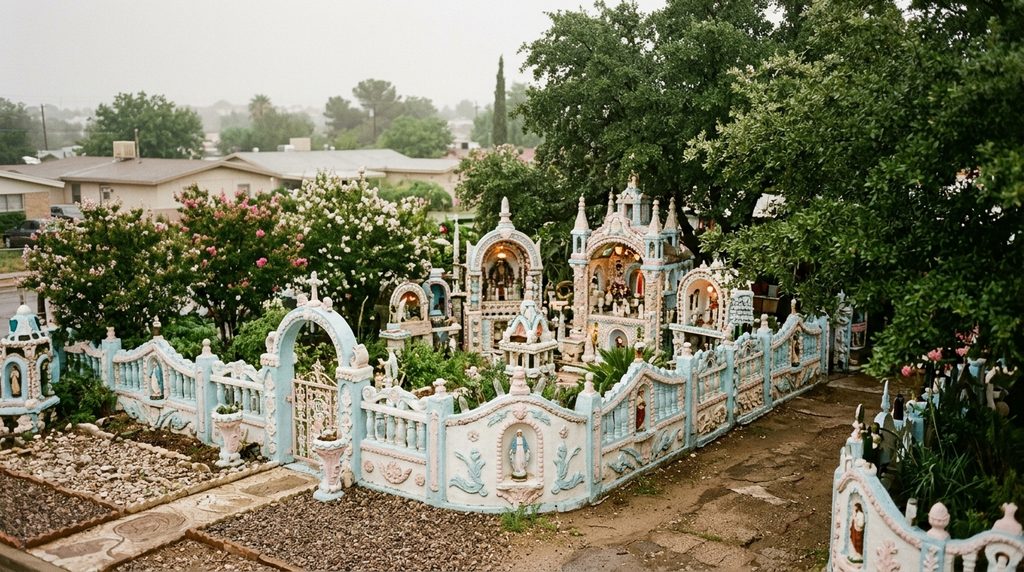
Also known as the Sugar House, this unique yard environment features handmade religious shrines and decorative fences built from cement cast in household molds, painted in pastel blue, white, and pink to resemble a glowing cake-top in the desert.
→ Three more weird outdoor & roadside oddities in El Paso & Fort Bliss — never the same twice
The story
In 1973, Rufino Loya Rivas—a Mexican immigrant who spent his working days stitching pockets onto jeans at El Paso's Levi Strauss manufacturing plant—bought a squat, unglamorous tract home on Leavell Avenue. Hemmed in by raw desert gravel and the hum of Highway 54, the place was uninspiring, but Loya made a vow to his wife, Celia: he would make the property something to be proud of. With no formal background in construction, masonry, or fine art, he bought sacks of Portland cement, mixed them in the yard, and taught himself how to sculpt.
For the next quarter-century, Loya poured off-shift hours into transforming the perimeter. He didn't order commercial balusters or decorative molds; he scavenged his own kitchen. Bowls, cups, and empty milk cartons served as casts for scalloped borders, pineapples, and bulbous finials. He cut discarded aluminum cans into petals to create everlasting metallic flowers, securing their cores with hammered bottle caps. Drawing deeply from memories of colonial Baroque basilicas in Mexico, he raised ornate columns topped with cherubs, framed elaborate window trims, and spent over 300 hours engineering a central exterior shrine dedicated to Our Lady of Guadalupe. Coated in thick coats of white, baby blue, and candy pink, the cured cement took on the uncanny sheen of royal cake icing.
Loya passed away in August 2022 at age 89, leaving behind one of the southwest borderlands' most singular visionary folk-art environments. It was never intended as a tourist attraction, but rather an enduring domestic promise—a private family home disguised as a confection, holding its own against the blowing Chihuahuan Desert dust.
What it's like
Leavell Avenue is an unassuming residential block running alongside Gateway South, and the property stops you cold: a blindingly pale, sugar-frosted perimeter wall covered in spiraled spires, cherubs, and recessed altars. This remains a private, occupied family home, so your visit is strictly curbside—never open the front gate, step inside the yard, or crowd the front windows. Stroll the public sidewalk slowly to catch the granular details, from the household mold seams in the concrete to the hand-sculpted panel honoring El Paso's 350th anniversary. Street parking along the curb is straightforward, but park respectfully and keep your visit quiet.
The move: Stay curbside on Leavell Avenue and circle the sugar-frosted wall, spotting cherubs, spiraled spires, and recessed altars, and guess which scalloped borders and pineapples were cast in kitchen bowls and milk cartons.
- 📍 El Paso, Texas
- 💸 Free
- ⚡ Up for anything
- 🌗 Outdoors
Where: 4301 Leavell Ave, El Paso, TX 79904, USA
Hours: Added 2026-11-17 — confirm current hours before you go.
Pair it with
- Ho Baron Sculpture Garden — Pair one legendary El Paso residential yard environment with another by heading across town to Ho Baron's corner lot, where towering bronze and cement gargoyles create a brooding counterpoint to Loya's pastel shrines.
- Dreadful Things — A short drive south on Montana Avenue, this curiosity shop trades Loya's sacred cement folk craft for a darker strain of regional oddities, taxidermy, and border counterculture.
- Scenic Drive Overlook & Murchison Park — After admiring Loya's hand-built tribute to El Paso's history at street level, climb the Franklin Mountains ridgeline for the sweeping cross-border panorama that framed his life.
More weird in El Paso & Fort Bliss
Good to know
Can you go inside the house or walk through the gated yard?
No. The Sugar House is a private residence, not a museum. The family lives here, and visits must be conducted entirely from the public sidewalk outside the fence.
How much does it cost to visit?
Viewing the house from the sidewalk is free. In years past, visitors occasionally offered small cash tips to the family to help offset maintenance and paint costs, but there is no formal admission.
Who built the Casa de Azúcar?
Rufino Loya Rivas, a retired Levi Strauss garment worker, single-handedly sculpted the entire exterior over a period spanning from 1973 into the late 1990s.
When is the best time to see it?
Visit during daylight hours when bright desert sun highlights the pastel paint and fine cement relief, but keep to normal daytime hours out of courtesy to the neighborhood.
Plan a visit & invite your people →
Further reading: nashersculpturecenter.org · kellyludwig.com · Atlas Obscura · texashighways.com · spacesarchives.org
last checked: 2026-11-17