Entry No. 44 — the Fayetteville & Fort Liberty file — filed under: miscellanea
Arsenal Park and the “Ghost” Tower
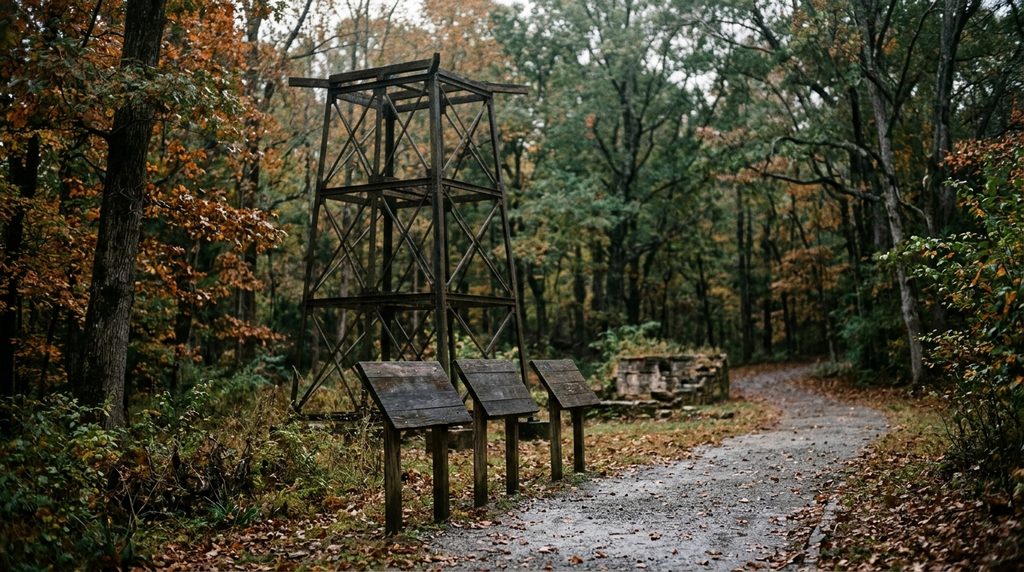
The park preserves remnants of the Fayetteville Arsenal, a 19th-century ordnance works that served both federal and Confederate governments. A feature identified as the “Ghost” tower stands by the Civil War Trail signs.
→ Three more weird outdoor & roadside oddities in Fayetteville & Fort Liberty — never the same twice
The story
After the War of 1812 caught the young United States short on weapons and coastal defense, the federal government commissioned a series of strategic arsenals, picking a high ridge in Fayetteville's Haymount neighborhood for one of them. Construction began in the late 1830s, relying heavily on the forced labor of enslaved workers alongside free craftsmen. By the time North Carolina seceded in April 1861, local militia marched in and claimed the near-finished brick fortress for the Confederacy. Over the next four years, the compound ran hot, turning out rifles, cartridges, and gun carriages for southern regiments until General William Tecumseh Sherman rolled through town in March 1865.
Sherman had no intention of leaving weapons facilities behind. He ordered his chief engineer, Orlando Poe, to batter, blast, and burn the works to zero. Poe unleashed the 1st Michigan Engineers, who attacked the industrial machinery with axes and sledgehammers before rigging artillery shells and running makeshift battering rams into the walls. By the time the smoke cleared, the complex was a field of pulverized brick. Decades later, highway planners carved the Martin Luther King Jr. Freeway straight through the middle of the grounds, scattering what little remained.
What marks the spot today isn't a replica, but an eerie structural diagram in the sky. To show visitors how massive the fortress once was, the state built the "Ghost Tower" directly on the stone footings of the original northwest corner tower. It is a full-scale, three-story skeleton made of painted steel beams, mapping the exact octagonal footprint that once anchored the compound's perimeter defense. Standing underneath it feels less like touring a battlefield and more like walking through a life-sized architectural blueprint left behind in a public park.
What it's like
Find parking off Arsenal Avenue or Myrover Street near the Museum of the Cape Fear complex, then follow the footpaths out onto the open grass. The Ghost Tower immediately commands the clearing—an empty geometric cage perched over sunken masonry footings and Civil War Trail markers, with traffic rushing past in the freeway cut below. You can walk right inside the steel perimeter, trace the surviving low foundation lines in the turf, and read the marker detailing the Michigan troops' sledgehammer demolition. The grounds are free, uncrowded, and open during daylight hours; late afternoon is best, when low sun throws long cage-like shadows across the lawn.
The move: Cross the grass, step inside the Ghost Tower’s empty steel cage together, and peer down at the sunken masonry while freeway traffic rushes below.
- 📍 Haymount, Fayetteville
- 💸 $$
- ⚡ Up for anything
- 🌗 Indoors
Where: 215 Myrover St, Fayetteville, NC 28305 (Arsenal Park — part of the Museum of the Cape Fear / Museum complex mailing address 801 Arsenal Ave, Fayetteville, NC 28305)
Hours: Added 2026-11-18 — confirm current hours before you go.
Pair it with
- 1897 Poe House — Located on the same museum grounds a few hundred feet away, this preserved Victorian home offers guided tours that contrast late-19th-century domestic life with the military ruins outside.
- U.S. Army Airborne & Special Operations Museum — Sitting just over half a mile down Hay Street, this downtown museum traces how Fayetteville evolved from a Civil War munitions depot into the premier hub of modern airborne warfare.
- Marker: Babe Ruth’s First Home Run — A quick 0.9-mile hop south to Gillespie Street brings you to an understated roadside plaque marking where nineteen-year-old Babe Ruth hit his first home run as a professional ballplayer in 1914.
More weird in Fayetteville & Fort Liberty
Good to know
What is the Ghost Tower actually made of?
It is an open-frame steel structure built to the exact three-story, octagonal dimensions of the original 1839 brick northwest tower.
Is Arsenal Park free to visit?
Yes. The outdoor park grounds and ruins are open to the public daily during daylight hours at no charge.
Did any buildings survive Sherman's 1865 demolition?
Only the nearby Arsenal House survived, reportedly spared after its resident, Edward Monaghan, appealed directly to General Sherman, his former pre-war acquaintance.
Where did the rest of the arsenal go?
Union engineers smashed and detonated the masonry in March 1865, and much of what was left was later bisected when the freeway was cut through the hill in the 20th century.
Plan a visit & invite your people →
Further reading: museumofthecapefear.ncdcr.gov · distinctlyfayettevillenc.com · battlefields.org · hmdb.org
last checked: 2026-11-18