Entry No. 45 — the Fayetteville & Fort Liberty file — filed under: miscellanea
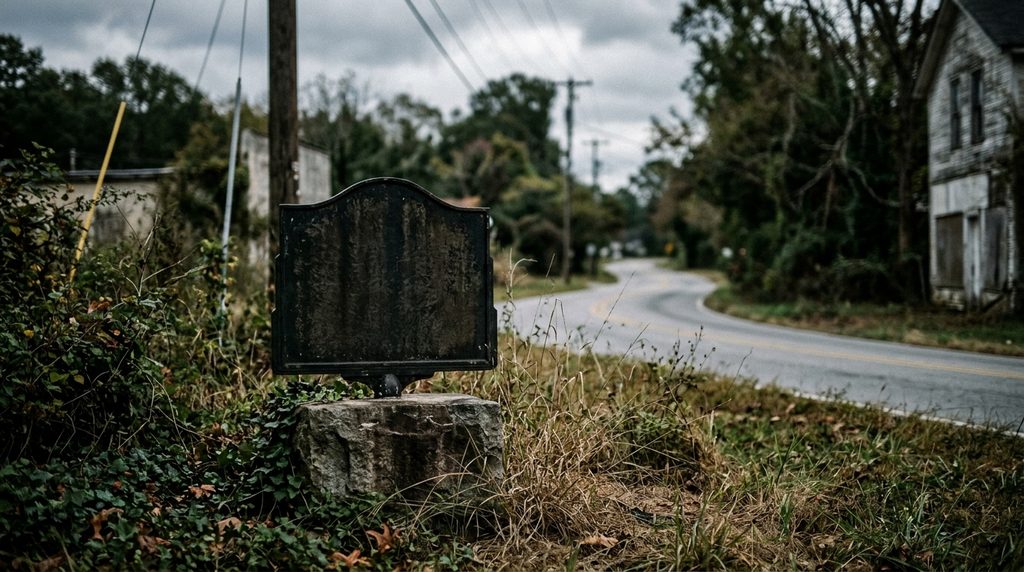
Marker: Babe Ruth’s First Home Run
This roadside marker commemorates the first home run Babe Ruth hit as a professional, in Fayetteville in March 1914.
→ Three more weird outdoor & roadside oddities in Fayetteville & Fort Liberty — never the same twice
The story
In March 1914, a nineteen-year-old George Herman Ruth had never traveled outside Baltimore. He was fresh out of St. Mary’s Industrial School for Boys—a Catholic reform school where his parents had sent him at age seven—and had just signed on with Jack Dunn’s minor-league Baltimore Orioles for $100 a month. Because Ruth was not yet legally of age to leave the school's custody, Dunn had to become his legal guardian. When the Orioles paused their train journey south in Fayetteville, Ruth checked into the Lafayette Hotel and immediately began riding the hotel's electric elevator up and down in wide-eyed amusement. Older veterans mocked the teenager's childish fascination and his legal tether to the manager by dubbing him 'Dunn’s baby.' The tag quickly contracted to 'Babe,' and it never came off.
On March 7, the team walked a mile down Gillespie Street to the Cape Fear Fair Grounds for an intra-squad scrimmage. They were so shorthanded that several local sportswriters were drafted onto the field to fill out rosters for the two improvised squads, the 'Buzzards' and the 'Sparrows.' In the final inning, Ruth stepped into the batter’s box and hammered a pitch roughly 135 yards—roughly 350 to 400 feet—over the right-field fence. It was the first home run he ever hit in a professional uniform. In a single afternoon on a dusty, half-forgotten fairground, baseball’s greatest mythos acquired both its nickname and its first registered long ball.
The fairground grandstands and basepaths vanished long ago, buried under post-war municipal growth and state pavement. In 1951, the state erected marker I-33 along the road shoulder, cryptically instructing passersby to cast their eyes '135 yds. N.W.' Today, that azimuth points directly into a bland spread of highway maintenance yards, chain-link fences, and utility lines. It is an aggressively unceremonious monument to a legendary origin story, preserved in a patch of roadside sod next to passing pickup trucks.
What it's like
The marker sits planted in the front lawn of the North Carolina Department of Transportation Division 6 office along Gillespie Street, right at the corner of Transportation Drive. There is no plaza, no turnstile, and no ticket booth—just a cast-iron historical sign staked near the curb. Gillespie Street traffic moves fast, so your best bet is turning onto Transportation Drive or using the adjacent state office parking lots to pull over. You only need five minutes: step onto the grass, read the metal tablet, and gaze 135 yards northwest into what is now highway equipment yards to triangulate where Ruth's ball clipped the trees.
The move: Turn onto Transportation Drive, find the cast-iron marker by the curb, and see who can do the better impression of a 19-year-old Babe Ruth taking another ride in the Lafayette Hotel elevator.
- 📍 Gillespie Street, Fayetteville
- 💸 Free
- ⚡ Up for anything
- 🌗 Outdoors
Where: Gillespie Street at/near the corner of Transportation Drive (also cited as near Franklin Street); postal reference ~600 Gillespie St, Fayetteville, NC 28301
Hours: Added 2026-11-18 — confirm current hours before you go.
Pair it with
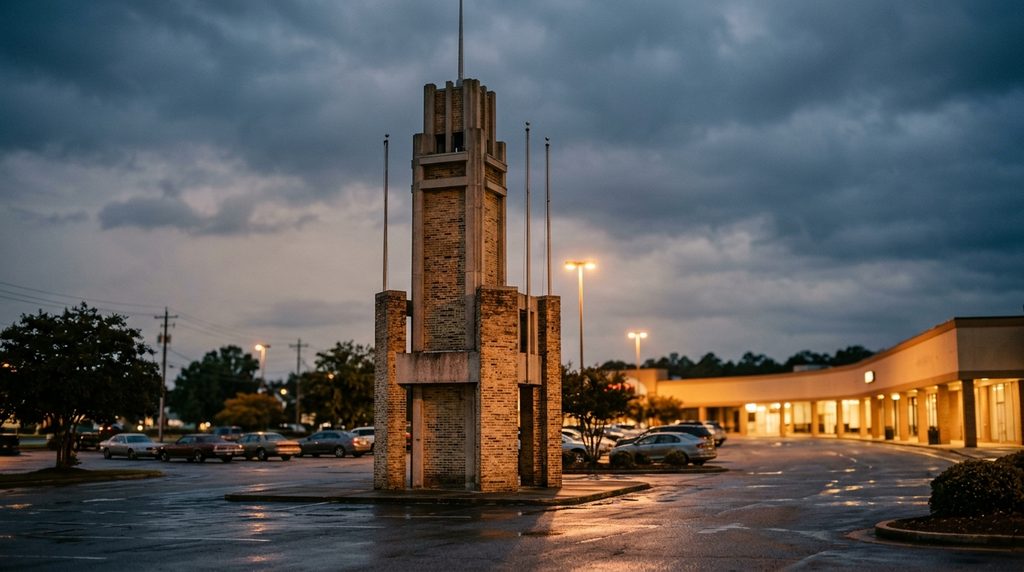
- Arsenal Park and the “Ghost” Tower — Continue tracking down Fayetteville's vanished landmarks less than a mile away at the skeletal tower marking the arsenal destroyed by Sherman in 1865.
- Circa 1800 — After standing in the highway grass, head into the downtown district where Ruth stayed for North Carolina farm-to-table fare and regional moonshine.
- Bound & Vine — Pair an obscure sports-history roadside dash with a quiet pour of wine and independent books just down the road.
More weird in Fayetteville & Fort Liberty
Good to know
Where did the home run ball actually land?
The marker directs you 135 yards northwest of its current spot, putting the original right-field boundary in what is now the fenced equipment yards and asphalt property belonging to highway and municipal facilities northwest of Transportation Drive.
Was this an official Major League home run?
No. Ruth was nineteen and playing minor-league ball for the Baltimore Orioles during spring training, hitting the ball in an intra-squad exhibition game between the 'Buzzards' and 'Sparrows.' His first official Major League home run arrived in May 1915 while pitching for the Boston Red Sox.
Does anything remain of the old Cape Fear Fair Grounds?
Nothing of the ballpark or fairgrounds remains at the site. If you want to see surviving photographs and artifacts related to Ruth's 1914 Fayetteville stay, stop by the Fayetteville Area Transportation and Local History Museum downtown.
Can you visit the Lafayette Hotel where he earned the nickname?
The original Lafayette Hotel building on downtown's Market Square was demolished in the mid-20th century, though downtown walking plaques still mark the general historic footprint.
Plan a visit & invite your people →
Further reading: Roadside America · Facebook · hmdb.org · dncr.nc.gov · sabr.org
last checked: 2026-11-18