Entry No. 48 — the Honolulu & Oahu file — filed under: miscellanea
Cultural Gardens at Daniel K. Inouye International Airport
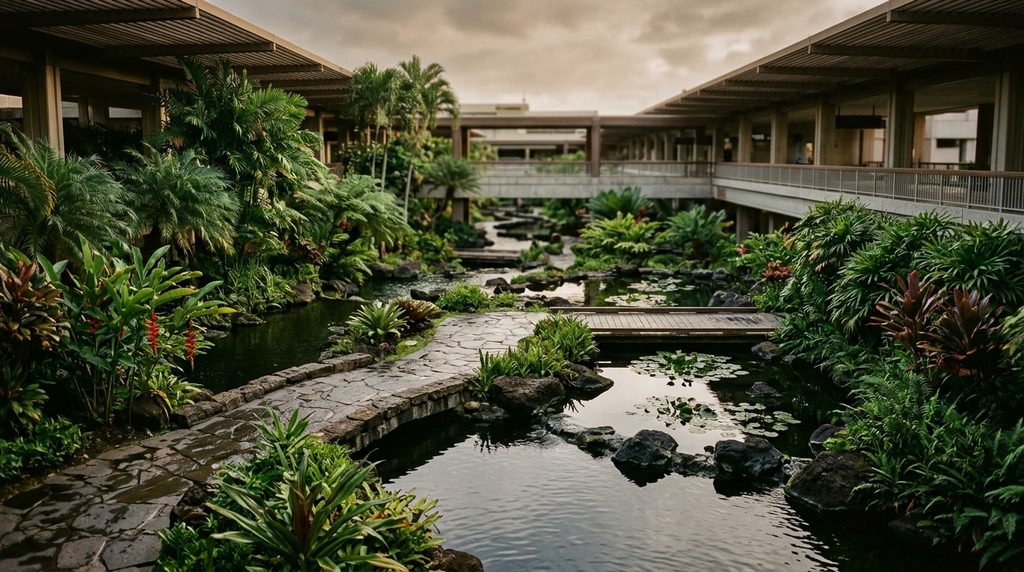
An airport garden environment where connected waterways flow among ponds and lakes to symbolize the intermingling of Hawaiʻi’s cultures.
→ Three more weird outdoor & roadside oddities in Honolulu & Oahu — never the same twice
The story
Most travelers shuffling through Honolulu's Daniel K. Inouye International Airport spend their layovers trapped in the sealed, fluorescent limbo of Terminal 2, utterly unaware of what sits directly beneath their feet. In 1962, when the airport's central jet-age complex was erected, landscape architect Richard C. Tongg—widely considered the grandfather of Hawaiian landscape architecture and the first recognized Chinese American practitioner in the field—was tasked with creating an outdoor respite. Rather than settling for a few potted palms, Tongg carved out an open-air, sunken courtyard split into three cultural enclaves: Chinese, Japanese, and Hawaiian.
Tongg did not treat the styles as superficial theme-park dressing; he linked them together through a contiguous system of waterways, streams, and ponds engineered to symbolize the synthesis of immigrant cultures in Hawaiʻi. In the Chinese section, an arched bridge crosses koi ponds to a red pavilion topped with yellow glazed tiles crafted by Hong Kong masons, standing near a bronze bust of Dr. Sun Yat-sen. Next to it, a traditional Japanese zigzag bridge—engineered according to folklore to foil straight-traveling malevolent spirits—leads past weeping willows and stone lanterns to a commemorative stone pagoda donated in 1968 to mark the centennial of the first Japanese contract laborers. Beyond the carp pools, the Hawaiian section drops waterfalls over volcanic basalt walls into lagoons fringed with ti, kukui, banana trees, and wild ginger.
The result is a strange collision of mid-century idealism and heavy civil infrastructure. You can sit on a shaded stone bench listening to mountain runoff splash across porous lava while 150-ton commercial jets spool up on the apron a few hundred feet away. It is an intact relic of 1960s civic ambition that airport efficiency never quite got around to paving over.
What it's like
You have to be a ticketed passenger past TSA security in Terminal 2 to reach the gardens; look for the nondescript stairs or elevators near the central E Gates concourse and take them down to the ground level. Downstairs, the gate-call PA announcements fade behind flowing water and rustling bamboo, and despite the thousands of travelers upstairs, the benches are almost always completely empty. Bring whatever meal you grabbed from the concourse, skip the linoleum boarding area, and wait out your delay under the eaves of the Chinese pavilion or beside the black-rock waterfall.
The move: Once you’re through Terminal 2 security, take the stairs near the central E Gates down to the sunken gardens, follow the linked ponds, and listen as rustling bamboo and running water soften the gate calls.
- 📍 Honolulu airport
- 💸 $$
- ⚡ Up for anything
- 🌗 Indoors
Where: 300 Rodgers Boulevard, Honolulu, HI 96819
Hours: Added 2026-11-17 — confirm current hours before you go.
Pair it with
- Chinese Hall at Moanalua Gardens — Located two miles inland from the airport, this Victorian-Chinese hybrid hall reflects the exact cross-cultural design philosophy Tongg incorporated into the terminal courtyards.
- La Mariana Sailing Club — Hidden in a gritty working marina less than two miles east, this unvarnished 1955 tiki bar provides the same time-capsule, mid-century atmosphere you get down in the airport gardens.
- Helena’s Hawaiian Food — Hit this legendary Kalihi storefront for pipikaula short ribs and kalua pig straight off the grill before you clear security and head down to the koi ponds.
More weird in Honolulu & Oahu

Good to know
Can I visit without an airline ticket?
No. The gardens are located strictly airside (post-security) inside Terminal 2, so you must clear TSA security with a valid boarding pass to access them.
Where inside the airport are the gardens located?
They occupy the ground-floor open-air courtyards situated beneath the Terminal 2 departure level, directly below the central concourse near the E Gates.
What is the purpose of the zigzag bridge?
The Japanese garden features a traditional yatsuhashi zigzag bridge, designed with sharp turns based on the folk belief that evil spirits can only travel in straight lines.
What are the operating hours?
Because the gardens are an open-air architectural feature within the secure perimeter of Terminal 2, they remain accessible 24 hours a day whenever the terminal is open.
Plan a visit & invite your people →
Further reading: airports.hawaii.gov · hidot.hawaii.gov · aviation.hawaii.gov · civilbeat.org · Atlas Obscura · beatofhawaii.com
last checked: 2026-11-17