Entry No. 28 — the Jacksonville & Mayport file — filed under: miscellanea
J.P. Small Memorial Park Baseball Museum
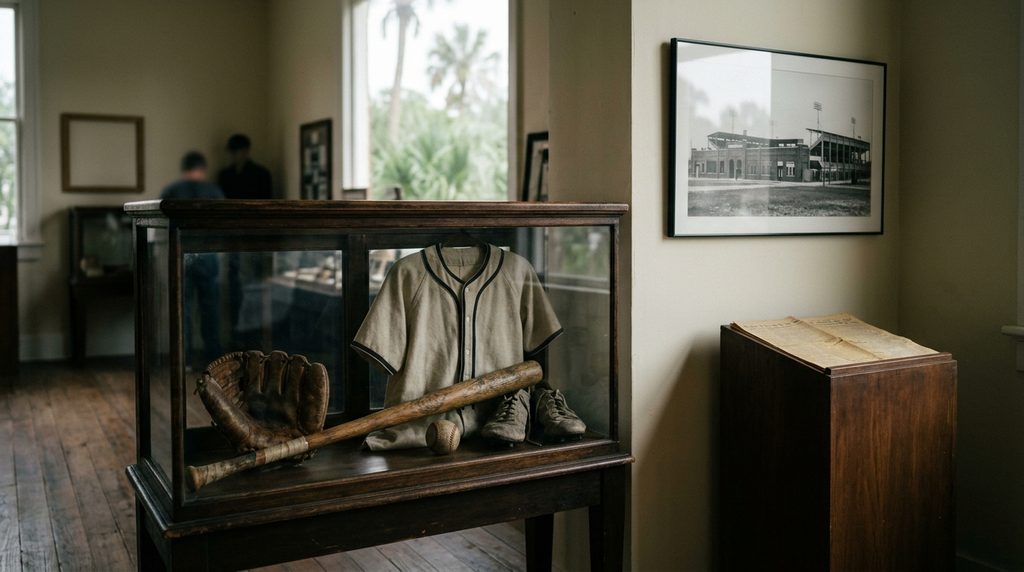
A museum devoted to the baseball history of one ballpark, which opened in 1912 and became home to the Negro American League’s Jacksonville Red Caps. Hank Aaron played here in 1953 as he and two teammates helped break organized baseball’s color barrier in the Deep South.
→ Three more unusual museums & collections in Jacksonville & Mayport — never the same twice
The story
Baseball has been played on this patch of turf along Myrtle Avenue since April 1912, when Barrs Field opened just days after the Titanic sank. The original wooden grandstand burned to ash in 1934, replaced a year later by the concrete stands that still stand watch over the foul lines. In 1938, luggage porters from the nearby Jacksonville Terminal—men who worked the rail lines wearing distinctive scarlet hats—formed the Jacksonville Red Caps of the Negro American League, playing under these lights before staging post-game concerts with the city’s top jazz musicians.
The diamond's most harrowing chapter unfolded in the spring of 1953. A 19-year-old shortstop named Hank Aaron stepped onto the field for the minor-league Jacksonville Braves, joined by teammates Félix Mantilla and Horace Garner. Together, they broke the color line in the Jim Crow South Atlantic League under relentless hostility from opposing dugouts and segregated stands. Aaron lived right down the block in Durkeeville, where he met his future wife, Barbara, before leaving town to rewrite baseball history.
Renamed in 1980 to honor beloved Stanton High School athletic director James P. Small, the stadium was slated for the wrecking ball in 1982 until neighborhood residents organized to stop the bulldozers. Outside stands a bronze statue of Negro League icon Buck O’Neil, who played for Edward Waters College down the road, while tucked inside the structure is an intimate museum loaded with Negro League memorabilia, period uniforms, and local Black sports archives.
What it's like
You are pulling up to an active, working neighborhood diamond, not an airbrushed commercial attraction; Edward Waters University and Stanton Prep still play their home games on the turf. The museum itself is tucked directly into the stadium structure, curated by the Durkeeville Historical Society and kept under lock and key when games aren't underway. To get inside the display rooms, you must submit a tour request via the historical society’s website in advance, though you can wander the perimeter and see the Buck O'Neil statue anytime.
The move: Arrange a museum visit, then find the display rooms tucked into the concrete stadium and trace the story from the Red Caps’ postgame jazz concerts to Hank Aaron’s 1953 season.
- 📍 Durkeeville, Jacksonville
- 💸 $
- ⚡ Up for anything
- 🌗 Indoors
Where: 1701 N Myrtle Ave, Jacksonville, FL 32209
Hours: Added 2026-11-17 — confirm current hours before you go.
Pair it with
- Durkeeville History Museum — Located less than half a mile away and run by the same historical society, this community archive fills in the story of the neighborhood where Hank Aaron lived during his 1953 season.
- El Modelo Block — Pair Durkeeville's survivor ballpark with this 1890s brick cigar factory downtown, which also survived devastating city blazes and retains a gritty early-1900s Jacksonville past.
- The Volstead — After touring the 1930s grandstands, head downtown behind the heavy velvet curtains of this hidden cocktail parlor for drinks rooted in the Prohibition era.
More weird in Jacksonville & Mayport
Good to know
How do you get inside the museum?
The museum space inside the stadium is operated in partnership with the Durkeeville Historical Society and is accessible by advance reservation or through scheduled neighborhood tours arranged via their website.
Is there an admission fee?
Admission to the stadium and its Negro League baseball museum is free, though the non-profit Durkeeville Historical Society welcomes donations to support preservation work.
Is baseball still played on this field?
Yes. The playing surface—officially christened Hank Aaron Ballfield in 2018—serves as the home field for Edward Waters University, Florida's oldest HBCU, and Stanton College Preparatory School.
What happened to the original 1912 ballpark structure?
The original wooden grandstand was destroyed by a fire in 1934; the current covered concrete grandstand was completed in 1935 and narrowly avoided city demolition in 1982.
Plan a visit & invite your people →
Further reading: thejaxsonmag.com · jacksonville.gov · news4jax.com · jaxdailyrecord.com · durkeevillehistoricalsociety.org · jaxhistory.org
last checked: 2026-11-17