Entry No. 32 — the London, UK file — filed under: miscellanea
Clapham South Deep-Level Shelter
An underground shelter beneath Clapham South station provided the setting for the London Transport Museum’s first Hidden London Halloween tour.
→ Three more unusual museums & collections in London, UK — never the same twice
The story
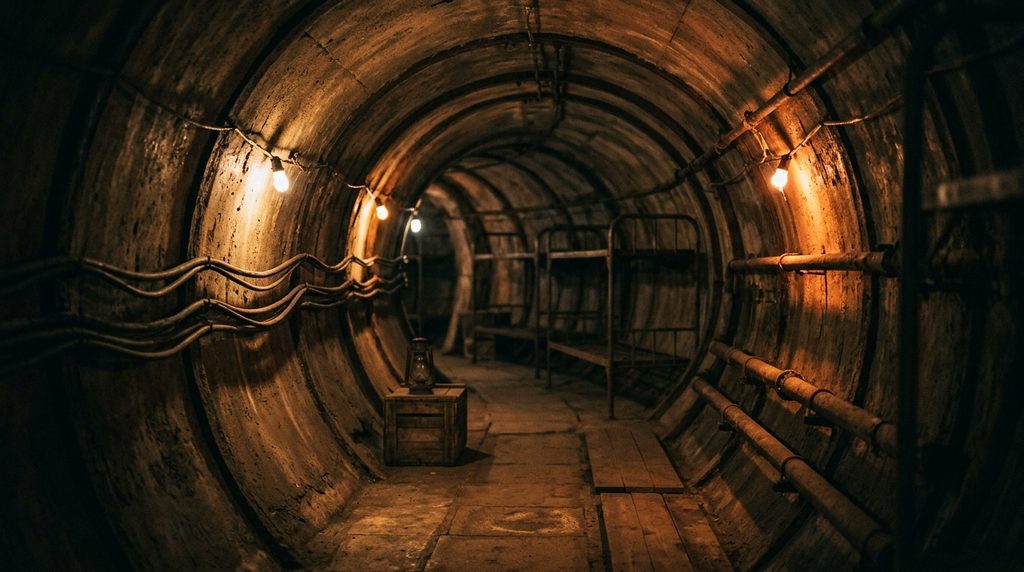
In 1940, as the Blitz pounded London, the Ministry of Home Security and London Transport devised an infrastructure gambit: construct ten bomb-proof shelters over 100 feet beneath existing Underground stations, with the quiet understanding that transport planners would link them after the war into a new express Tube line. Only eight were finished. Clapham South was dug out as two parallel, 16.5-foot-wide tunnels over 1,200 feet long, split horizontally into upper and lower decks. When it finally opened to the public in 1944 under the threat of V-1 flying bombs, it functioned as a self-contained subterranean fortress sleeping up to 8,000 Londoners on three-tier bunk beds, supported by chemical sluice toilets, medical aid posts, and warden stations.
The post-war express rail line never happened, leaving Whitehall with an enormous subterranean cavern looking for a purpose. In June 1948, roughly 240 Jamaican passengers from the HMT Empire Windrush who lacked lodging were billeted on the shelter's bunks for up to four weeks—a stopgap that effectively seeded south London's Caribbean community because the nearest employment exchange was down the road in Brixton. Three years later, authorities converted the tunnels into the 'Festival Hotel,' offering budget bunks to visitors attending the 1951 Festival of Britain. The subterranean boarding era ended abruptly in 1956, after a fire in the sister shelter at Goodge Street took three days to extinguish and proved that housing humans under an active Tube network was a disaster risk.
What it's like
You gather on Balham Hill outside the Marks & Spencer Foodhall before your London Transport Museum guide leads you into an unassuming concrete surface drum and down a spiraling 180-step shaft. There is no elevator, no heating, and no operating plumbing down below. The two long tunnel decks feel cavernous, cool, and chalky, with the acoustic rumble of live Northern line trains periodically shaking the cast-iron tunnel rings overhead. Tours run 75 minutes and cover roughly a mile of walking past original steel bunk frames, hand-lettered sector signs, and reconstructed warden bunks; wear sturdy, flat shoes you don't mind coating in historic dust.
The move: Follow your guide down the 180 spiralling steps into the cool, chalky wartime shelter and pause together to listen for the rumble of a Northern line train.
- 📍 Clapham South
- 💸 $$
- ⚡ Up for anything
- 🌗 Indoors
Where: Balham Hill, London SW12 9EA (meet in front of Marks & Spencer Food Hall)
Hours: Added 2026-11-18 — confirm current hours before you go.
Pair it with
- Sewing Machine Museum — Hop one stop south down the Northern line to Balham to swap subterranean civilian defense tunnels for an equally obsessive industrial collection of Victorian stitching machinery.
- The Cinema Museum — Ride the Northern line north into Kennington to move from wartime underground dormitories straight into a cavernous former Victorian workhouse brimming with vintage projectors and celluloid relics.
- British Vintage Wireless and Television Museum — Head across toward Dulwich to match the shelter's 1940s home-front atmosphere with a backyard maze of period radios, gramophones, and pre-war broadcast apparatus.
More weird in London, UK
Good to know
How deep is the shelter and is there an elevator?
The tunnels sit approximately 100 to 120 feet below ground level and are accessed via 180 spiral steps; there is no working passenger lift and no step-free access.
Can you visit the shelter without a guided tour?
No. The shelter is a secure, listed subsurface structure and is accessible only on scheduled 'Hidden London' guided tours operated by the London Transport Museum.
Are there bathrooms or storage lockers inside?
There are no functioning toilets, cloakrooms, or storage facilities inside the shelter tunnels; visitors must use nearby public facilities or local businesses before entry.
Why were the deep-level shelters permanently closed for accommodation?
In 1956, a fire inside the Goodge Street deep-level shelter smoldered for three days, forcing authorities to abandon residential and hotel use across all eight sister shelters due to evacuation dangers.
Plan a visit & invite your people →
Further reading: ltmuseum.co.uk · historicengland.org.uk · bbc.co.uk · newsshopper.co.uk · subbrit.org.uk
last checked: 2026-11-18