Entry No. 35 — the London, UK file — filed under: miscellanea
St Bartholomew the Great
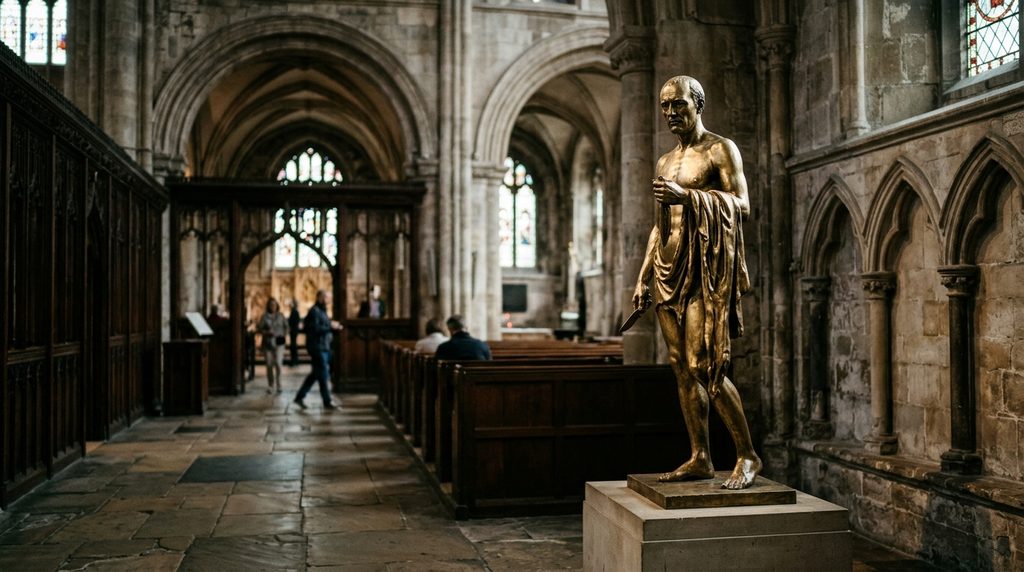
This parish church, founded in 1123, contains Damien Hirst’s Exquisite Pain. The sculpture depicts St Bartholomew with his flayed skin hanging over one arm.
→ Three more weird outdoor & roadside oddities in London, UK — never the same twice
The story
Founded in 1123 by Rahere—a courtier to King Henry I who took holy vows after falling desperately ill on a pilgrimage to Rome—St Bartholomew the Great is London's oldest surviving parish church. It was originally an immense Augustinian priory, but when Henry VIII dissolved the monasteries in 1539, the crown demolished its ten-bay nave and sold off the rubble. Over the centuries that followed, the truncated remnants of the church were rented out for profane commerce: the Lady Chapel did shifts as a fringe factory, a blacksmith's forge, and a printing house where a teenage Benjamin Franklin set type in 1725.
The church miraculously dodged the Great Fire of 1666, and in 1915 a Zeppelin bomb dropped on Smithfield shook off Georgian brick cladding to accidentally reveal the 1595 half-timbered Tudor gatehouse perched over its 13th-century stone archway. Step past the heavy Norman drum piers into the south transept and you hit an unexpected jolt: Damien Hirst’s *Exquisite Pain*. Cast in 2006, the eight-foot, 24-carat gilded bronze sculpture depicts St Bartholomew flayed down to his raw musculature, calmly holding his own empty skin draped over his arm like a coat. Rather than the butcher's knife typical of medieval iconography, Hirst armed him with a modern surgical scalpel and medical scissors—a direct nod to neighbouring St Bartholomew’s Hospital and the blurry line between anatomy, torture, and faith.
What it's like
You enter off West Smithfield through the Tudor gatehouse, walking a stone path that cuts across what used to be the nave before Henry VIII stripped the roof. Inside, the church is cavernous, cold, and smells heavily of old masonry; the massive 12th-century Romanesque arches feel completely detached from the glass-and-steel City outside. Hirst's statue stands in the south transept, catching whatever dim daylight filters down to illuminate its peeled tendons and the hollow face hanging from its arm. It remains a functioning parish with free entry, though volunteer wardens will point you toward donation tap-points near the door.
The move: Slip through the Tudor gatehouse off West Smithfield, feel the chill under the Norman arches, then find Hirst’s St Bartholomew in the south transept with his own skin slung over one arm.
- 📍 City of London
- 💸 $$
- ⚡ Up for anything
- 🌗 Indoors
Where: West Smithfield, London EC1A 9DS
Hours: Added 2026-11-18 — confirm current hours before you go.
Pair it with
- Ye Olde Mitre — A five-minute walk across Farringdon leads to this hidden 16th-century tavern tucked down an alley, continuing the cloistered medieval mood over pints in wood-panelled snugs.
- Hunterian Museum — If Hirst's peeled musculature caught your attention, head west to inspect John Hunter’s genuine 18th-century anatomical dissections and surgical specimens preserved in jars.
- London’s Roman Fort — Walk five minutes east to dive even deeper into London's past, tracking down surviving second-century Roman defensive walls hidden within a functional subterranean car park.
More weird in London, UK
Good to know
How much does it cost to visit St Bartholomew the Great?
General admission is free for visitors, though cash and card donations are strongly encouraged at the door to fund the upkeep of the 900-year-old structure.
What is the story behind Damien Hirst's statue inside?
Titled Exquisite Pain, the 2006 gilded bronze work portrays St Bartholomew, who was martyred by being flayed alive. Hirst rendered him with medical accuracy and equipped him with a surgical scalpel and scissors instead of a martyr's knife, referencing the neighbouring St Bartholomew’s Hospital.
Why does the entrance look like a Tudor house?
A timber-framed house built in 1595 sits over the priory's 13th-century stone portal. It was bricked over in the 18th century and largely forgotten until a German Zeppelin raid in 1915 detonated nearby, blasting off the facade and exposing the Elizabethan timber framework.
What famous historical figures are associated with the church?
Founder Rahere is entombed beside the high altar beneath a 15th-century stone canopy, and an 19-year-old Benjamin Franklin worked in the Lady Chapel in 1725 when it operated as Samuel Palmer's print shop.
Plan a visit & invite your people →
Further reading: lookuplondon.substack.com · goldentours.com · theartnewspaper.com · Wikipedia · nationalchurchestrust.org
last checked: 2026-11-18