Entry No. 34 — the London, UK file — filed under: miscellanea
St Olave Hart Street
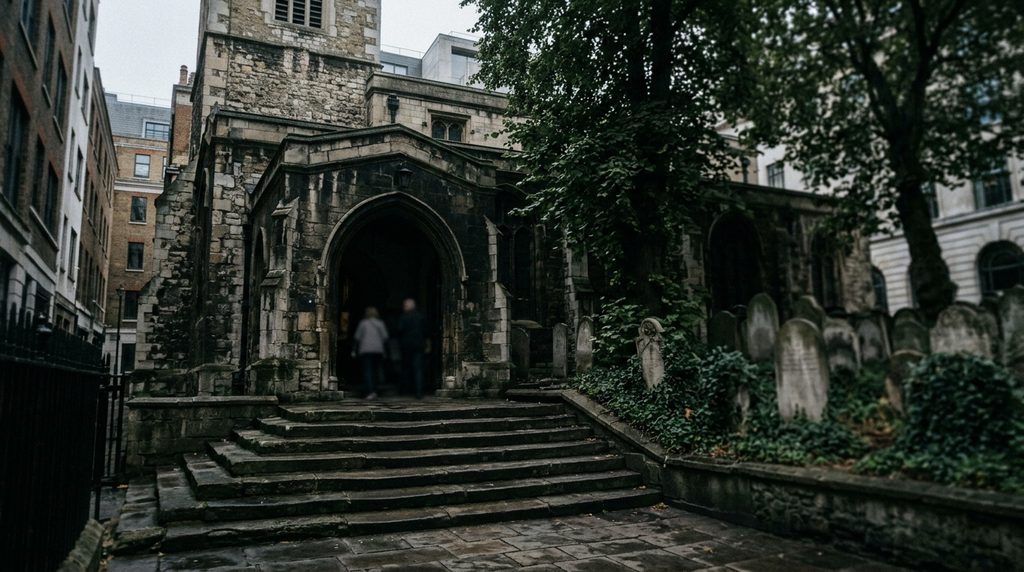
Visitors descend steps into the church because the graveyard ground is said to have risen from the sheer number of victims buried there during the 1665 plague. The church survived the Great Fire and was restored after Blitz damage.
→ Three more haunted places & dark-history spots in London, UK — never the same twice
The story
Look up at the stone entrance arch on Seething Lane before you push the gate: three carved limestone skulls grin down under spiked iron spears, installed in 1658 as a grim memento mori. Two centuries later, Charles Dickens fixated on them in 'The Uncommercial Traveller', nicknaming the parish 'Saint Ghastly Grim' for its jail-like ironwork and impaled teeth. When you step through the doorway and enter the nave, you immediately walk down steps. The building didn't sink; the ground outside rose. In 1665, the Great Plague dumped 365 victims into this tiny parish plot—including Mary Ramsay, the woman local burial registers accused of introducing the pestilence to the district. Diarist Samuel Pepys walked through the yard in January 1666 and recorded his dread at seeing the graves lying swollen so high above street level.
Pepys lived across the street at the Navy Office and had a private exterior staircase built straight from his quarters into an elevated gallery in the church. In September 1666, he climbed St Olave's stone tower to survey the Great Fire advancing across London, then helped save the church by ordering dockyard workers to blow up surrounding timber houses with gunpowder to create a firebreak. It worked, leaving St Olave as one of the handful of medieval churches to survive the inferno. The sanctuary's luck ran out on May 11, 1941, when German incendiary bombs tore through the roof, but it was painstakingly restored in 1954 with help from King Haakon VII of Norway, honoring the church's 11th-century patron, the Viking warrior king Olaf Haraldsson.
Inside, Samuel and his wife Elizabeth remain locked in a perpetual staring contest. When Elizabeth died of fever at age twenty-nine in 1669, Samuel commissioned a marble bust high on the sanctuary wall, positioned so her likeness looked directly toward his private pew. In 1883, a memorial bust to Pepys was installed on the opposite wall where his gallery once stood, angling his face back toward hers across the empty nave. Beneath them, accessible via a low stair when open, sits a vaulted 13th-century crypt that predates the plague by hundreds of years.
What it's like
Tucked away behind Fenchurch Street, St Olave is deeply quiet compared to the commuter roar outside. Enter from Hart Street or via the spiked gate on Seething Lane; the church is generally open to visitors on weekdays during business hours, with choral recitals frequently filling the nave on Wednesday and Thursday lunchtimes. The interior feels like an ancient village church trapped among City skyscrapers, smelling of old masonry, timber, and polished brass. The 13th-century crypt is occasionally open or accessible upon polite request to the verger, while the raised churchyard garden offers benches, a small herb plot honoring 16th-century botanist William Turner (also buried here), and a pavement labyrinth.
The move: Look up at the three limestone skulls grinning over the Seething Lane gate, then cross the plague churchyard and step down into the quiet nave.
- 📍 City of London
- 💸 $$
- ⚡ Up for anything
- 🌗 Indoors
Where: 8 Hart Street, City of London, EC3R 7NB
Hours: Added 2026-11-18 — confirm current hours before you go.
Pair it with
- St Dunstan in the East Church Garden — Walk two blocks south to contrast St Olave’s meticulous post-Blitz restoration with a sister church London chose to leave as an overgrown, open-air ruin.
- Philpot Lane Mice Sculpture — A short walk west shifts the scale from life-sized macabre skull carvings to London's tiniest outdoor sculpture: two mice squabbling over cheese.
- Discount Suit Company — Shake off the churchyard damp by slipping into this low-lit subterranean cocktail bar hidden in an old tailor's storeroom near Aldgate.
More weird in London, UK
Good to know
Why do visitors have to walk down steps to enter the church?
Over centuries of intensive burials—culminating in the 1665 Great Plague, when 365 parishioners were interred here in a single year—the soil level of the surrounding churchyard rose significantly higher than the medieval nave floor.
Why did Charles Dickens call it 'St Ghastly Grim'?
In his 1860 collection 'The Uncommercial Traveller', Dickens dubbed it 'Saint Ghastly Grim' after being fascinated by the 1658 Seething Lane gateway, carved with life-sized skulls and crossbones pierced by iron spikes.
Where are Samuel and Elizabeth Pepys buried?
Both lie buried in the chancel beneath the church floor. Their memorials face each other across the aisle: Elizabeth's 1669 bust on the north wall and Samuel's 1883 monument where his Navy Office pew once stood.
How did the building survive the Great Fire of 1666?
Samuel Pepys and naval officers ordered nearby houses blown up with gunpowder, creating a firebreak that stopped the flames just yards short of the church walls.
Plan a visit & invite your people →
Further reading: lookuplondon.substack.com · Wikipedia · Atlas Obscura · layersoflondon.org · Official site · spitalfieldslife.com
last checked: 2026-11-18