Entry No. 62 — the London, UK file — filed under: miscellanea
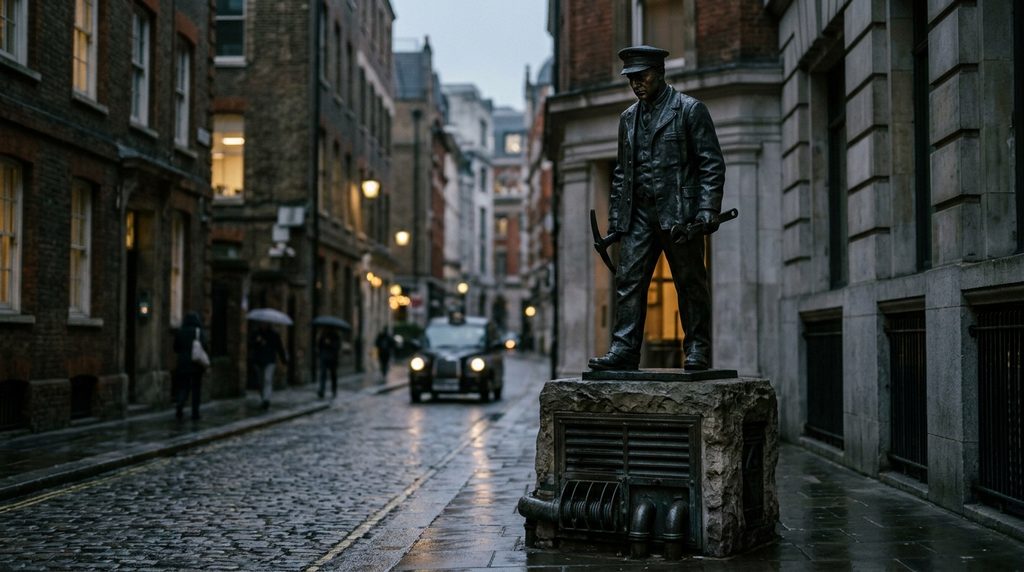
Statue of James Henry Greathead
A statue of a London Underground engineer conceals a ventilation shaft for the Tube lines beneath the street.
→ Three more weird outdoor & roadside oddities in London, UK — never the same twice
The story
At first glance, the bronze figure stranded on a traffic island outside the Royal Exchange looks like standard Victorian civic decoration: a bearded man in a broad-brimmed hat, clutching rolled papers, gazing serenely down Cornhill. Look closer at the plinth. Circling the stone base just beneath his feet is a dark, continuous iron grille, and if you listen closely over the idling taxis, you can hear the subterranean rumble of Bank station. The statue is an exhaust pipe in disguise.
The man commemorated is James Henry Greathead, a South African-born engineer who revolutionized modern tunneling. Before his work, early Tube lines relied on disruptive "cut-and-cover" trenching that tore up surface streets. Greathead perfected a cylindrical iron boring shield that allowed miners to push deep through London's wet clay without triggering collapses above. The technique made deep-level Tube networks viable, including the City and South London Railway—now the Northern line—which runs directly beneath this stretch of road.
Greathead died in 1896, but this monument only appeared in 1994, sculpted by James Butler. Its installation was sparked by disaster: following the deadly 1987 King’s Cross station fire, transport authorities mandated supplemental ventilation shafts across deep Tube junctions. The City of London objected to planting an industrial blast vent in the middle of its grandest financial junction, so planners devised camouflage: hollow out an oval Portland stone pedestal, house the intake and exhaust system inside, and cap the flue with the engineer whose shield dug the tunnels.
What it's like
Visiting requires merely timing the pedestrian signals at Bank junction to step out onto the traffic island in the middle of Cornhill. The spot is loud, exposed, and flanked by constant bus traffic, but you can walk right up to the base to examine the slatted metal vent separating the bronze statue from its stone pedestal. On cold days, drafts of underground Tube air waft through the grille. If you head down into Bank station afterward, follow the passageway linking toward the Waterloo & City line to spot an actual recovered arc of Greathead's cast-iron tunneling shield bolted to the wall and painted bright red.
The move: Step onto the Cornhill traffic island outside the Royal Exchange to listen for the subterranean rumble of Bank station and feel drafts of underground Tube air wafting through the statue’s hidden ventilation grille.
- 📍 City of London
- 💸 Free
- ⚡ Up for anything
- 🌗 Outdoors
Where: Cornhill, London EC3V 3NR (traffic island in the middle of Cornhill, outside the Royal Exchange, near Bank junction)
Hours: Added 2026-11-18 — confirm current hours before you go.
Pair it with
- London Mithraeum Bloomberg SPACE — Walk one block west to trade 19th-century Tube engineering for the subterranean remains of a 3rd-century Roman temple preserved beneath Bloomberg's headquarters.
- Philpot Lane Mice Sculpture — Swap a disguised ten-foot civil engineer for London's smallest public monument, perched on a ledge a two-minute walk away.
- London’s Roman Fort — Keep exploring the Square Mile's concealed infrastructure by tracking down Roman defensive walls preserved inside an operational parking garage.
More weird in London, UK
Good to know
Where is the ventilation shaft visible on the statue?
Look at the seam where the bronze base meets the Portland stone pedestal: a continuous metal vent grille runs all the way around the oval plinth to cycle air to and from Bank station below.
Why was the statue erected nearly a century after Greathead died?
Greathead died in 1896, but London Underground only required the shaft after safety reforms following the 1987 King’s Cross station fire mandated extra ventilation at major deep-level interchanges.
Can you see any of Greathead's original shield equipment nearby?
Yes. Down inside Bank station, in the pedestrian walkway connecting to the Waterloo & City line, an original section of a Barlow-Greathead iron shield was uncovered during renovations and remains displayed on the wall, painted red.
Plan a visit & invite your people →
Further reading: Atlas Obscura · Wikipedia · londonist.com · layersoflondon.org
last checked: 2026-11-18