Entry No. 63 — the London, UK file — filed under: miscellanea
The Molehill on the Equestrian Statue of William III
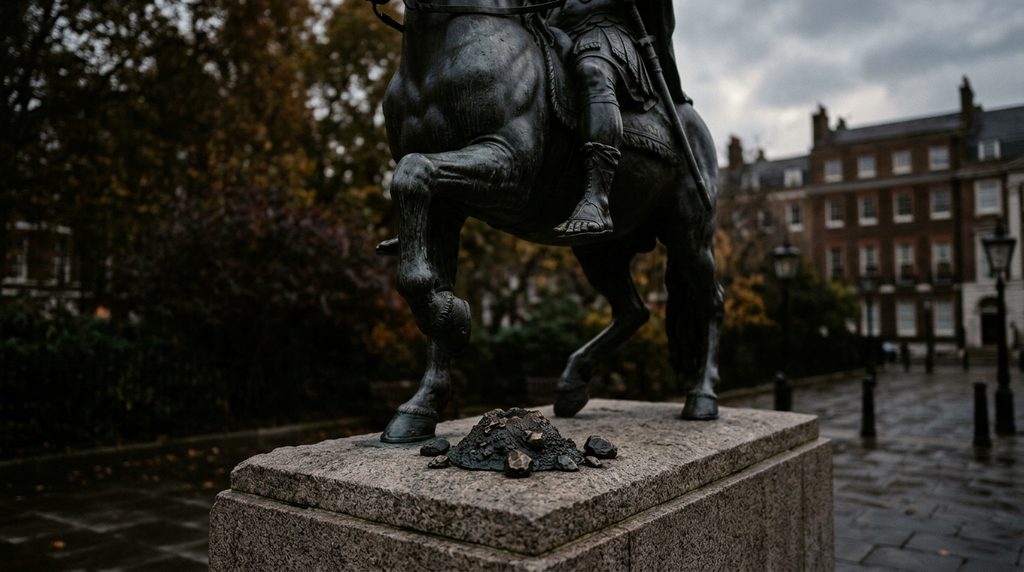
Look beneath the horse on this statue of William III dressed as a Roman. The sculpture includes the molehill that toppled the king.
→ Three more weird outdoor & roadside oddities in London, UK — never the same twice
The story
At first glance in the middle of St James's Square, you are looking at conventional imperial pageantry: King William III recast as a Roman emperor, draped in a classical toga while stubbornly crowned with a voluminous seventeenth-century periwig, perched on a bronze horse. But look down past the saddle and the flanks to the bronze surface just beneath the horse's near-hind hoof. There sits a distinct, textured earthen lump. It is a sculpted molehill, and it represents the single pettiest cause of royal mortality ever cast into civic bronze.
The bronze mound memorializes William's unceremonious death in 1702. While galloping his mount, Sorrel, through the grounds of Hampton Court Palace, the horse stepped into a mole burrow and stumbled. The king was thrown, breaking his collarbone; the injury brought on a fever and pulmonary complications that killed him two weeks later. In private clubs across Britain and abroad, deposed Jacobite loyalists toasted the subterranean creature that had rid them of the Protestant usurper, raising clandestine glasses "to the little gentleman in the black velvet coat."
The monument's backstory was nearly as clumsy as the king's demise. Proposed in 1697 while William was still alive, the scheme languished for over a century. A crown official and MP named Samuel Travers left a bequest in 1724 to fund an equestrian statue, but sculptor John Bacon the Elder didn't draft a model until 1794—and died before casting it. His son, John Bacon Junior, finally completed and erected the bronze in 1808, borrowing heavily from John Michael Rysbrack's earlier statue of the king in Bristol. Yet Bacon the Younger went out of his way to retain the fatal molehill, ensuring the monarch's most embarrassing moment remained permanently underfoot.
What it's like
St James's Square is an island of hush ringed by hedge funds, gentlemen's clubs, and the London Library. The square's central garden is technically private but opens to the public on weekdays until roughly 4:30 pm (or dusk in winter). To spot the detail, step up to the Portland stone pedestal and walk around to the horse's hindquarters; the bronze molehill is clearly visible right under the rear left hoof. Outside weekday daytime hours the perimeter gates are padlocked, though with good light and keen eyesight you can still view the horse's hooves through the wrought-iron fence.
The move: Step up to the equestrian monument in St James's Square and circle to the horse's hindquarters to spot the subtle, sculpted bronze molehill that caused the king’s fatal fall.
- 📍 St James's Square, London
- 💸 Free
- ⚡ Up for anything
- 🌗 Outdoors
Where: St James's Square, London SW1Y 4LE
Hours: Added 2026-11-18 — confirm current hours before you go.
Pair it with
- Giro, the Nazi Dog’s Grave — Walk two minutes south down the Duke of York Steps to see London's other bizarre animal-related political memorial tucked beneath the plane trees of Carlton House Terrace.
- British Optical Association Museum — Head four-tenths of a mile east toward Charing Cross to trade a tiny outdoor sculpture detail for an appointment-only townhouse room crammed with historic spectacles and optical oddities.
- Gordon's Wine Bar — Follow Pall Mall east to Villiers Street and duck into vaulted 1890s cellars lit entirely by candlelight to decompress after the quiet square.
More weird in London, UK
Good to know
Where exactly is the molehill located on the monument?
Circle around to the rear of the sculpture; the bronze mound is tucked directly under the horse's back-left hoof on the plinth surface.
When is the garden open to visitors?
St James's Square garden is typically open to the public Monday through Friday until around 4:30 pm. It is locked on weekends and holidays, though the statue remains visible through the perimeter railings.
Why was the molehill included in an official monument?
Sculptor John Bacon Junior finished the piece in 1808, more than a century after William's 1702 fall. Rather than softening the history, he included the mound as a factual nod to the Hampton Court hunting accident that broke the king's collarbone and ended his reign.
What did the Jacobites mean by 'the little gentleman in black velvet'?
It was a satirical toast popular among Jacobites who supported the deposed Catholic King James II, celebrating the mole whose burrow tripped William III's horse.
Plan a visit & invite your people →
Further reading: Atlas Obscura · livinglondonhistory.com · Wikipedia · historicengland.org.uk · onlondon.co.uk
last checked: 2026-11-18