Entry No. 31 — the London, UK file — filed under: miscellanea
Giro, the Nazi Dog’s Grave
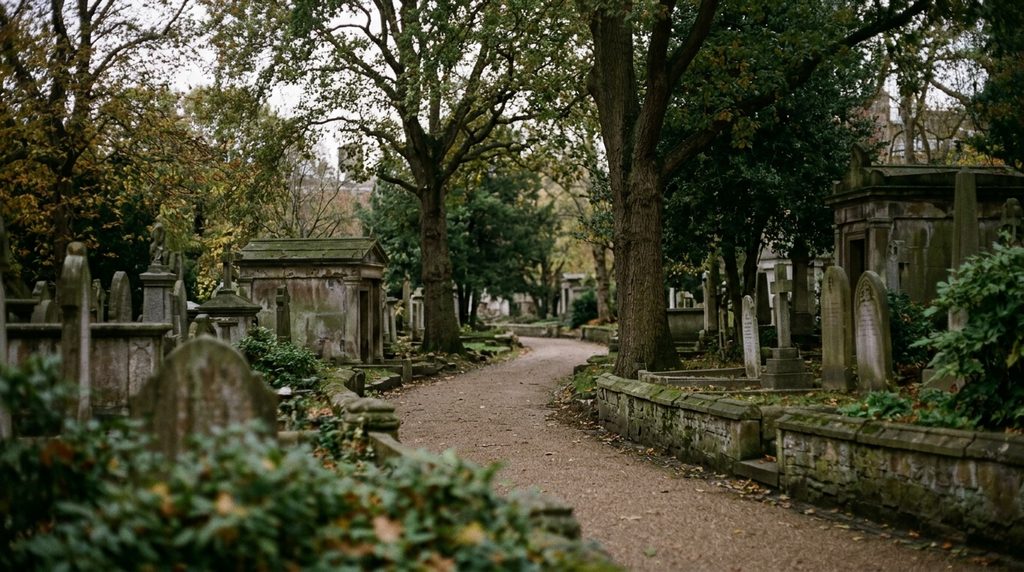
A small grave near the Mall commemorates Giro. Historic UK describes it as the country’s only memorial to a Nazi dog.
→ Three more haunted places & dark-history spots in London, UK — never the same twice
The story
At the top of the Duke of York Steps, where the grand Regency stucco of John Nash’s Carlton House Terrace meets the ceremonial path toward The Mall, thousands of tourists stride past an extraordinary micro-monument without ever looking down. Tucked behind black iron railings at the roots of a towering plane tree sits a small headstone sheltered inside a miniature wooden and perspex box. The five-line German inscription is spare and dignified: "Giro" / Ein treuer Begleiter! / London im Februar 1934. / Hoesch. Translated, it reads: "Giro. A faithful companion! London in February 1934. Hoesch." Historic UK and local lore routinely dub it the country’s only memorial to a Nazi.
The dog in question was a pet terrier—or Alsatian, depending on which contemporary observer you consult—belonging to Dr. Leopold von Hoesch, Germany’s ambassador to the United Kingdom. Hoesch took up residence at No. 9 Carlton House Terrace in November 1932 on behalf of the democratic Weimar Republic. An impeccably dressed, widely admired career diplomat and Anglophile, he hosted celebrated embassy gatherings and maintained warm ties with British politicians. When Adolf Hitler took power in 1933, Hoesch found himself representing the Third Reich by proxy, though he frequently pushed back against Berlin's extremist diplomacy, including Hitler's remilitarisation of the Rhineland. In February 1934, tragedy struck the embassy garden when Giro chewed through an exposed electrical wire and died of electrocution. A grief-stricken Hoesch buried his pet in the grounds and placed the marker above him.
Hoesch himself died suddenly of a stroke inside the embassy just two years later, receiving a full British-led military cortege draped in a swastika flag that marched past Buckingham Palace en route to Dover, before Joachim von Ribbentrop took over the post. Giro’s stone vanished from public memory until the late 1960s, when contractors excavating an underground car park beneath the terrace uncovered it from the dirt. Workers salvaged the headstone and re-erected it under the plane tree outside, meaning Giro’s physical bones remain somewhere beneath the concrete while his memorial endures in plain sight.
What it's like
Head to the landing at the top of the Duke of York Steps, turn toward the corner of No. 9, and peer through the iron security railings into the dirt at the foot of the large London plane tree. You're searching for an A-frame wooden kennel box with a plastic faceplate protecting the small stone. On bright afternoons, window glare on the scratched perspex makes the chiselled German text hard to read, so lean in against the railings and tilt your phone camera to cut the reflection. It is an unexpectedly quiet, odd little corner, completely ignored by the crowds cutting down toward St James's Park.
The move: At the top of the Duke of York Steps, peer through the iron railings by No. 9 and see how much of Giro’s German epitaph you can make out through the scratched Perspex.
- 📍 Off the Mall, Westminster
- 💸 $$
- ⚡ Up for anything
- 🌗 Indoors
Where: 9 Carlton House Terrace, London SW1Y 5AG (behind railings at the top of Duke of York Steps / corner with Waterloo Place, under a large tree)
Hours: Added 2026-11-18 — confirm current hours before you go.
Pair it with
- The Molehill on the Equestrian Statue of William III — Stroll two minutes north into St James's Square to find another subtle piece of outdoor political spite: the bronze molehill sculpted under King William III's horse to mark the mound that tripped his mount.
- Gordon's Wine Bar — Walk ten minutes down toward Embankment to swap embassy oddities for London's oldest subterranean wine cellar, lit entirely by candlelight beneath arched Victorian brickwork.
- Farting Lane — Head along the Strand to Carting Lane behind the Savoy to check out London's sole surviving sewer-gas lamp, another obscure piece of outdoor street engineering hiding in plain sight.
More weird in London, UK
Good to know
Was the dog actually a Nazi?
No. Giro belonged to Leopold von Hoesch, who came to Britain representing the democratic Weimar Republic before Hitler took power in 1933. While Hoesch served out his posting under the Third Reich until his death in 1936, he was a traditional diplomat who resisted Nazi party influence; Giro earned the sensational moniker purely because the embassy flew the swastika at the time of the dog's death.
Is Giro still buried beneath the gravestone?
Almost certainly not. Giro was originally buried in the private embassy garden behind the house in 1934. During late-1960s construction of an underground car park, the headstone was dug up and relocated to its current spot beneath the tree, leaving the actual remains buried or lost under modern tarmac.
Can you access the memorial directly?
No, the headstone sits on private property behind locked perimeter railings. You can stand on the public pavement just a couple of feet away and photograph it easily through the iron bars.
Why is the gravestone inside a wooden box?
The kennel-style wooden frame and perspex screen were added in the 1990s to protect the soft, weathered stone and its hand-carved inscription from outdoor damp and London grime.
Plan a visit & invite your people →
Further reading: historic-uk.com · Wikipedia · Atlas Obscura · mylondon.news
last checked: 2026-11-18