Entry No. 29 — the Manchester, UK file — filed under: miscellanea
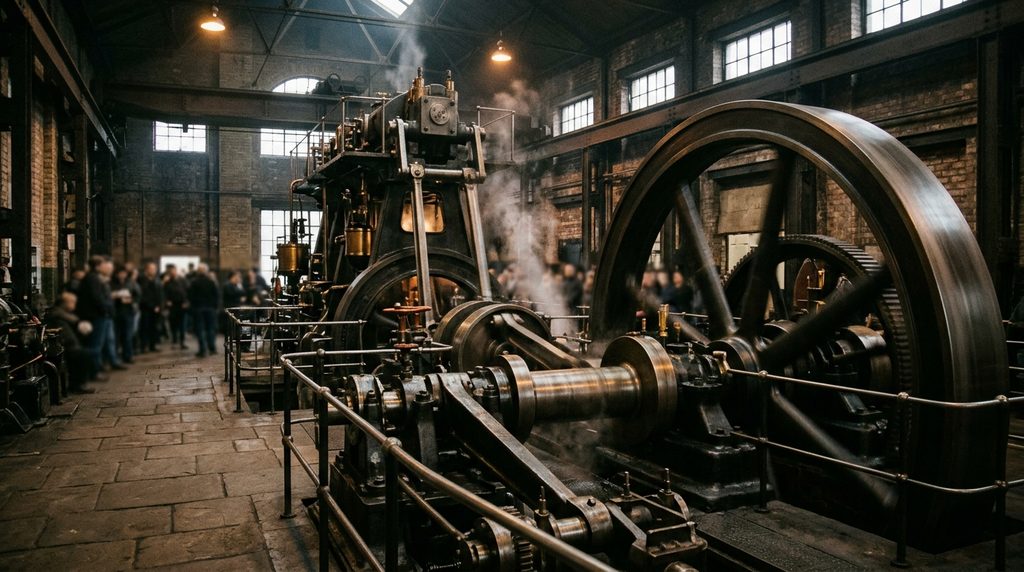
Ellenroad Engine House Steam Museum
The museum is built around the world’s largest working steam mill engine, which powered Ellenroad Ring Mill from 1917. The article describes it being fired up on the first Sunday of the month.
→ Three at a time, never the same twice — explore weird Manchester, UK
The story
When Lancashire's cotton empire dismantled itself across the twentieth century, almost every engine house was stripped for scrap, dynamited, and paved over. Ellenroad survived through sheer stubborn scale and good fortune. In 1916, a fire gutted the original mill in Newhey, but rather than downgrade, the owners commissioned Blackburn engineers Clayton, Goodfellow & Co. to overhaul the twin engines into an absurdly powerful tandem compound plant. They named the twin cylinders Victoria and Alexandra, hooked them to an 80-ton flywheel, and drew 3,000 horsepower from a battery of coal-fired Lancashire boilers vented through a 220-foot brick chimney.
The mill finally ceased production in 1975, and when the spinning blocks were leveled in the 1980s, ink manufacturer Coates Brothers bought the site. Instead of cutting up the machinery, they preserved the engine house and granted a long lease to the volunteer-run Ellenroad Trust. Today, tucked away behind an ordinary industrial estate, sits the largest working steam mill engine remaining on the planet—kept alive by retired engineers who shovel coal by hand to build head of steam just as workers did a century ago.
What it's like
You smell Ellenroad before you see it: sharp coal smoke, mineral lubricating oil, and damp steam pooling in the shadow of that enormous chimney. Arriving on a regular weekday means a quiet walk through towering, cold cast iron, but show up on the first Sunday of the month—steaming day—and the entire brick chamber hums through the soles of your shoes as the 80-ton flywheel begins to roll. The catch is that century-old boiler hardware is temperamental; if pressure tests fail or parts seize, the engines stay static (though the volunteers will usually open the gates for free or cheap when that happens). Bring ear protection if low-frequency mechanical thumping rattles you, and don't miss the 1841 Whitelees beam engine tucked into the former boiler house.
The move: Visit on the first Sunday of the month to smell coal smoke and lubricating oil, feeling the brick floor hum through your soles as the massive eighty-ton flywheel begins to roll.
- 📍 Rochdale, Greater Manchester
- 💸 $
- ⚡ Up for anything
- 🌗 Indoors
Where: Elizabethan Way, Newhey, Rochdale, Greater Manchester, OL16 4LG
Hours: Added 2026-11-20 — confirm current hours before you go.
Pair it with
- Ring O’ Bells Pub — Follow up the coal-smoke engineering spectacle with a pint in Middleton, where centuries-old pub lore tells of Royalists ambushed in an underground passage and buried under the cellar flagstones.
- Uppermill — Drive just five miles east into the Pennine hills to trade colossal spinning machinery for a quiet, self-guided stroll beneath Uppermill's stone viaducts and local folklore stops.
- Boggart Hole Clough — Balance the brute mechanical logic of 3,000 horsepower with a detour into this ancient wooded ravine in North Manchester, reputedly haunted by a spiteful, farmhouse-wrecking boggart.
More weird in Manchester, UK
Good to know
When do they actually run the main steam engines?
Steaming days are held on the first Sunday of each month, when volunteers fire the coal boiler to spin Victoria and Alexandra. On other open dates, you are touring the machinery cold.
What happens if there is a mechanical breakdown on a steam day?
Because these engines and boilers are well over a century old, technical issues occasionally prevent steam-up. When this happens, the museum typically opens anyway for static viewings, often waiving the standard admission fee.
How do you reach the museum on public transit?
Take the Manchester Metrolink tram toward Rochdale and get off at Newhey station. The engine house is roughly a five-to-ten-minute walk down Elizabethan Way.
What else is preserved inside the engine house?
Alongside the massive Victoria and Alexandra engine, the collection includes the 1841 Whitelees beam engine built by John Petrie & Co, an 1860s horizontal mill engine named Irene, and historic steam sprinkler pumps.
Plan a visit & invite your people →
Further reading: manchestersfinest.com · visitrochdale.com · Wikipedia · lancashirepast.com · ellenroad.org.uk · gracesguide.co.uk
last checked: 2026-11-20