Entry No. 27 — the Sierra Vista & Fort Huachuca file — filed under: miscellanea
Patterson Observatory
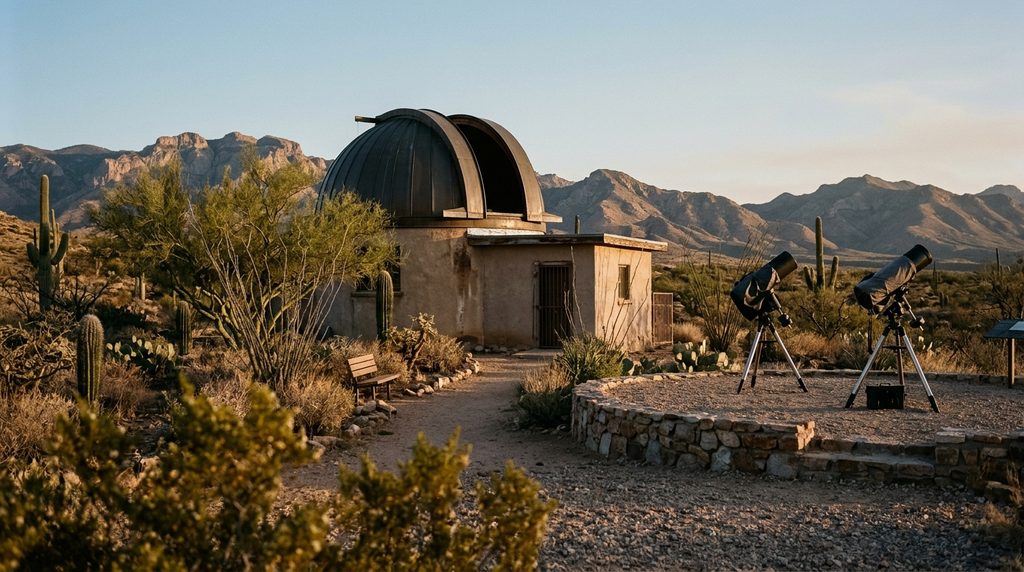
Described as the 'best kept secret in Sierra Vista' and the first public astronomical observatory in Cochise County, this facility opens to the public once a month for night sky viewing through its telescopes.
→ Three at a time, never the same twice — explore weird Sierra Vista & Fort Huachuca
The story
Sierra Vista isn't where you expect to stumble across a serious research-grade observatory dome. Tucked behind the desert scrub on the University of Arizona Sierra Vista campus, the Patterson Observatory looks almost surreptitious between ordinary academic parking lots. Opened in September 2004 through funding from the nonprofit University South Foundation, the facility was planted here specifically to exploit Cochise County's ink-black darkness, which is safeguarded by some of the lowest commercial sign illumination codes in the nation.
Under its 16-foot dome sits a 20-inch Ritchey-Chrétien telescope—an optical machine capable of capturing celestial bodies roughly one million times fainter than what human eyes can detect. The peculiar charm of the place, however, is that it isn't locked behind university credentials or staffed by stiff docents reading canned scripts. Instead, operation is handed over to the amateur obsessives of the Huachuca Astronomy Club, who run the gear with the conspiratorial eagerness of enthusiasts letting you in on the universe's private mechanics.
What it's like
You will navigate a dim campus lot off Colombo Avenue and follow the faint red flashlights toward the white dome. Public nights are held only once a month, starting about half an hour after sunset, and require a free advance RSVP through the foundation's website because the dome interior is tight. You'll wait your turn to step up to the 20-inch eyepiece, but the secret is outside: club members frequently set up their own sophisticated scopes across the tarmac, letting you wander between views of planetary rings and distant nebulae without a queue. Bundle up heavier than the daytime weather suggests, as the dome is kept unheated to prevent image-distorting thermal currents, and always check the sky before heading out—even partial cloud cover scrubs the event, and the facility shuts down completely during the July and August monsoon season.
The move: Follow the faint red flashlights across the dim campus lot after sunset and step up to the 20-inch telescope inside the white dome for a rare look into ink-black skies.
- 📍 Sierra Vista
- 💸 $
- ⚡ Low-key
- 🌗 Outdoors
Where: 1140 N Colombo Ave, Sierra Vista, AZ 85635
Hours: Added 2026-11-18 — confirm current hours before you go.
Pair it with
- The Hoppin’ Grapes Wine & Craft Beer Bar — Defrost after an evening in the unheated observatory dome with local Arizona wine pours and self-serve craft beer taps just two miles away.
- Murray Springs Clovis Archaeological Site — Spend the daylight hours standing over 13,000-year-old mammoth kill grounds before switching your scale from prehistoric dirt to deep-space millions of light-years away.
- Sierra Vista Historical Society & Henry F. Hauser Museum — Visit the local historical museum earlier in the day to trace the valley's military and human past before you look upward through the Patterson eyepiece.
More weird in Sierra Vista & Fort Huachuca
Good to know
How much does it cost, and do I need a reservation?
Public nights are free, but you must register in advance through the University South Foundation website (usfaz.org) to claim a viewing slot since space inside the 16-foot dome is strictly capped.
When are public viewing sessions held?
Public viewing nights occur once per month, usually kicking off about thirty minutes after sunset. The observatory suspends public sessions entirely during July and August due to monsoon clouds.
What happens if the weather turns bad?
Viewing is strictly weather-dependent. If the sky is overcast or threatening rain, the session is called off; visitors should check the foundation's event status line before driving out.
What kind of telescope will I look through?
The main instrument inside the dome is a 20-inch aperture Ritchey-Chrétien telescope, supplemented outdoors by Huachuca Astronomy Club members' personal refractors and reflectors.
Plan a visit & invite your people →
Further reading: visit.sierravistaaz.gov · explorecochise.com · ssvec.org · usfaz.org · hacastronomy.org · nightsky.jpl.nasa.gov
last checked: 2026-11-18