Entry No. 22 — the Watertown & Fort Drum file — filed under: miscellanea
Sterlingville
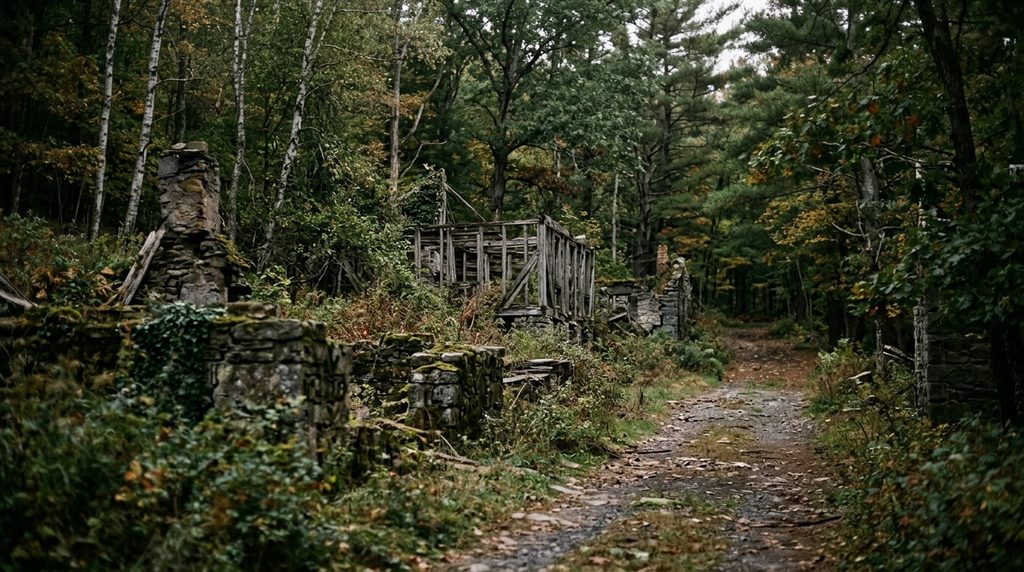
One of several lost hamlets destroyed and abandoned when the military base expanded over former civilian settlements, its remnants are featured on specialized local history tours exploring the 'ghosts' of Fort Drum.
→ Three at a time, never the same twice — explore weird Watertown & Fort Drum
The story
In early 1941, the U.S. War Department decided to expand Pine Camp by 75,000 acres to train armored divisions for World War II. In doing so, it wiped five thriving North Country settlements off the map. The largest of them was Sterlingville. Founded in the 1830s by iron baron James Sterling around a cold-blast charcoal furnace on Black Creek, it had grown into a self-sufficient industrial hamlet complete with two churches, a schoolhouse, a Limburger cheese factory, a sawmill, and hundreds of residents. Then came the eviction notices: 525 families across the region were bought out with mere weeks to pack their lives into trucks and leave.
What followed was erasure by ordnance. More than 3,000 buildings across the annexed parcel were dismantled, sold off, or reduced to rubble during live-fire artillery drills. But Sterlingville didn't entirely disappear. Today, deep inside Fort Drum's restricted impact and maneuver zones, the hamlet exists as a surreal hybrid of ghost town and tactical training ground. Cellar holes and blast furnace masonry are swaddled in industrial geotextile fabric and held down with sandbags—an archaeological preservation technique that allows 10th Mountain Division soldiers to practice armored vehicle checkpoints directly over 19th-century ruins without crushing them.
The woods have reclaimed the street grid, but the cemeteries remain stubborn outposts of civilian memory. Out on the old Plank Road sits Gates Cemetery, where James Sterling lies buried inside a heavy cast-iron fence surrounded by the graves of his blast furnace workers. Down by Black Creek is the Savage-Varley Catholic cemetery, where parishioners in the winter of 1885 physically dragged their church building across the frozen creek ice to move it into town. Aside from the dull thump of heavy artillery and passing military convoys, almost no one walks these crossroads except the few civilians who manage to secure seats on the military installation's tightly controlled, guided history tours.
What it's like
Do not attempt to roll up here on a Sunday drive; Sterlingville sits inside an active military installation and trespassing into tactical zones carries federal charges. Your only reliable ticket in is the official 'Lost Villages' tour operated periodically by Fort Drum’s Cultural Resources Program, which requires advance registration and fills up quickly. You will pass security checkpoints, board an Army-escorted bus, and bounce down tactical gravel roads into areas normally closed for live maneuvers. The experience is stark and windy: you'll step off into silent clearings where iron grave markers and sandbagged building foundations sit surrounded by tank tracks, military warning signs, and dense brush.
The move: Register in advance for the base’s Lost Villages tour to clear security checkpoints and explore the ruined 1830s iron-furnace hamlet rubble swallowed by military training grounds.
- 📍 Fort Drum
- 💸 $$
- ⚡ Up for anything
- 🌗 Indoors
Where: Fort Drum Military Installation, Jefferson County, NY (no public street address; restricted military training area)
Hours: Added 2026-11-18 — confirm current hours before you go.
Pair it with
- LeRay Mansion — Pair this with LeRaysville, another hamlet erased by the 1941 military expansion whose 19th-century estate house managed to survive behind base gates.
- Sheepfold Cemetery — Continue the phantom settlement theme at another isolated historic burial ground marooned within Fort Drum's secure perimeter.
- 10th Mountain Division Heritage Collection — Visit the base museum to understand the combat division that took over the land where Sterlingville's families once lived.
- The Crystal Restaurant — Decompress after touring restricted military ruins with roast beef and a cold drink inside Watertown's oldest continuously operating dining hall, founded in 1925.
More weird in Watertown & Fort Drum

Good to know
Can you visit Sterlingville on your own without a tour?
No. The site is located entirely within Fort Drum's restricted military training area. Independent entry is strictly forbidden, and civilian access is limited to organized historical tours or specific recreation permits granted through Fort Drum's iSportsman system for designated cemeteries during non-training periods.
What happened to the original buildings?
When the federal government seized the land in 1941, residents were forced to vacate. Some structures were moved off-base on flatbed trailers, while the rest were demolished or used as targets for tactical maneuvers and weapons training over subsequent decades.
Why are sandbags covering the cellar holes?
Fort Drum’s Cultural Resources staff covers historic foundations with protective geotextile sheeting and sandbags to prevent soil erosion and ensure military units can conduct tactical drills in the area without destroying the underlying 19th-century masonry.
Who was James Sterling?
He was a regional ironmaster who tapped local ore deposits from Antwerp and built a cold-blast charcoal furnace and forge on Black Creek in the late 1830s, establishing the industrial village that took his name. His grave sits in Sterlingville's Protestant Gates Cemetery.
Plan a visit & invite your people →
Further reading: syracuse.com · army.mil · home.army.mil · nyheritage.contentdm.oclc.org · jeffcowiki.miraheze.org · fortdrum.isportsman.net
last checked: 2026-11-18