Entry No. 51 — the London, UK file — filed under: miscellanea
Kirkaldy Testing Museum
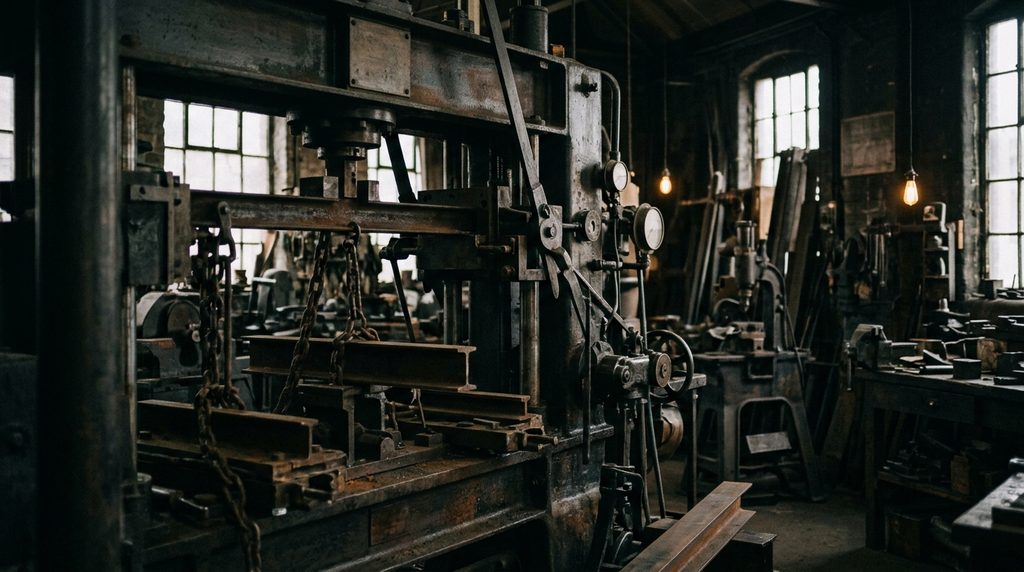
A Victorian materials-testing workshop still has David Kirkaldy’s working 1874 machine, built to measure the strength of materials for projects such as the Tay Bridge.
→ Three at a time, never the same twice — explore weird London, UK
The story
Carved into the stone arch above the doorway at 99 Southwark Street is a four-word rebuke to Victorian industrial hubris: "Facts not Opinions." When Scottish engineer David Kirkaldy opened this purpose-built materials-testing house on New Year’s Day 1874, bridge builders and railway barons were throwing up iron megastructures based largely on optimistic guesswork—and spans were violently collapsing across Britain as a result. Kirkaldy’s business model was brutal and honest: clients paid him to pull, crush, bend, and shear their raw construction materials until they snapped, and he delivered back unflinching measurements of precisely where they failed. He refused to give polite design opinions; he only dealt in empirical destruction.
The room is dominated by Kirkaldy’s 47-foot-long, 116-ton patented Universal Testing Machine. Built in Leeds by Greenwood and Batley, the iron monster was so massive that architect Thomas Roger Smith had to anchor it to dedicated brick piers driven into the basement below. Over a century of commercial operation, this hydraulic giant broke materials for the world's most ambitious infrastructure: granite and iron for Joseph Cubitt’s Blackfriars Railway Bridge, steel for the Sydney Harbour Bridge, and metal for the 1951 Festival of Britain Skylon. Most notoriously, the court of inquiry brought Kirkaldy the fractured wrought iron from the lethal 1879 Tay Bridge disaster to pinpoint why the bridge gave way.
Three generations of the Kirkaldy family ran tests here until the works finally closed in the 1970s. While the surrounding neighborhood swapped industrial wharves for glass-fronted offices, 99 Southwark Street stayed frozen in time. Instead of being sterilized behind museum ropes, the equipment is preserved in working condition by a volunteer crew of practicing and retired engineers who still lubricate the fittings and demonstrate the machinery under pressure.
What it's like
Stepping inside means stepping directly off a busy Southwark pavement into a workshop smelling intensely of engine oil, grease, damp masonry, and old wood paneling. There are no interactive touchscreens or gift shops; you will be guided by volunteer engineers who walk you through original testing benches, a 1906 chain-testing machine in the basement, and the gigantic green tensometer itself. The crucial detail is access: public opening days typically happen only once or twice a month (often the first Sunday for general open visits and set dates for live machine demonstrations), and tickets for the live runs must be booked online well ahead of time.
The move: Step under the carved “Facts not Opinions” motto into the oil-scented workshop and try to take in all 47 feet of Kirkaldy’s green testing machine while a volunteer explains how it broke things.
- 📍 Bermondsey, Southwark
- 💸 $
- ⚡ Up for anything
- 🌗 Indoors
Where: 99 Southwark Street, London SE1 0JF
Hours: Added 2026-11-18 — confirm current hours before you go.
Pair it with
- Old Operating Theatre Museum & Herb Garret — A fifteen-minute walk east takes you from Kirkaldy's physical stress tests of metal straight into the realm of Victorian surgical dissection in an atmospheric church attic.
- Statue of James Henry Greathead — Cross London Bridge into the City to inspect a bronze memorial honoring another Victorian civil engineering icon, complete with a plinth that secretly functions as a working Tube ventilation shaft.
- Call Me Mr Lucky — Decompress from heavy Victorian hydraulic engineering half a mile away in London Bridge, where an offhand password at a diner counter sends you downstairs into a lantern-lit cocktail den.
More weird in London, UK

Good to know
When can you visit?
Kirkaldy Testing Museum is run entirely by volunteers and is not an everyday drop-in museum. It typically opens to the public on the first Sunday of each month, with pre-booked guided tours and machine demonstration events running on specific dates.
Do you get to see the 116-ton machine run?
The volunteers do run the Universal Testing Machine during dedicated live demonstration tours, but not on every casual visit. If you want to see the hydraulic ram in action, book a designated machine run tour online in advance.
Is the museum accessible for wheelchair users?
The ground floor—where the massive Universal Testing Machine is located—has mostly level access, with a single step into Kirkaldy's preserved office. However, the basement housing the chain tester is reachable only via stairs.
Where did the phrase 'Facts not Opinions' come from?
David Kirkaldy had the motto carved above the entrance to state his philosophy: he was paid to record hard, scientific data on where materials broke, refusing to offer personal opinions on building projects or flatter clients.
Plan a visit & invite your people →
Further reading: designmynight.com · Reddit · Wikipedia · historicengland.org.uk · testingmuseum.org.uk · Atlas Obscura
last checked: 2026-11-18